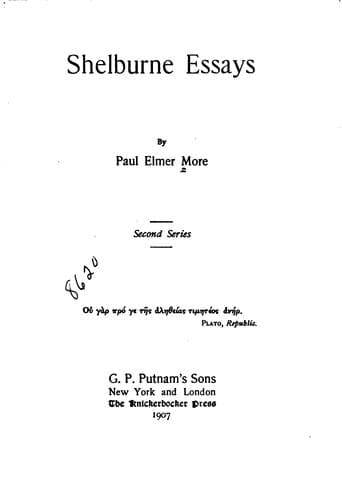
American literature -- History and criticism; English literature -- History and criticism
And what is the impression of the man himself that remains after living
with his works for several months? The frankness with which he parodies
his own eccentricities might seem to indicate a becoming modesty, and
yet that is scarcely the word that rises first to the lips. Indeed, when
I read in the very opening of the Dedicatory Epistle that precedes the
present edition of his poems such a statement as that "he finds nothing
that he could wish to cancel, to alter, or to unsay, in any page he has
ever laid before his reader," I was prepared for a character quite the
contrary of modest, and as I turned page after page, there became fixed
in my mind a feeling that I should hesitate to call personal
repulsion--a feeling of annoyance at least, for which no explanation was
present. Only when I reached _Atalanta in Calydon_, in the fourth
volume, did the reason of this become evident. That poem, exquisite in
many ways, is filled with talk of time and gods, of love and hate, of
life and death, of all high-sounding words that lend gravity to poetry,
and yet in the end it is itself light and not grave. The very needless
reiteration of these words, their bandying from verse to verse, deprives
them of impressiveness. No, a true poet who respects the sacredness of
noble ideas, who cherishes some awe for the mysteries, does not buffet
them about as a shuttlecock; he uses them sparingly and only when the
thought rises of necessity to those heights. There is a lack of
emotional breeding, almost an indecency, in Swinburne's easy familiarity
with these great things of the spirit.
Public-domain text, read in full here on John Shaqi.
Reviews
Reviews
No reviews yet
Be the first to share your thoughts on this work.
Join the Discussion
Join the discussion
Sign in to leave a comment or review.
Sign InorCreate an account