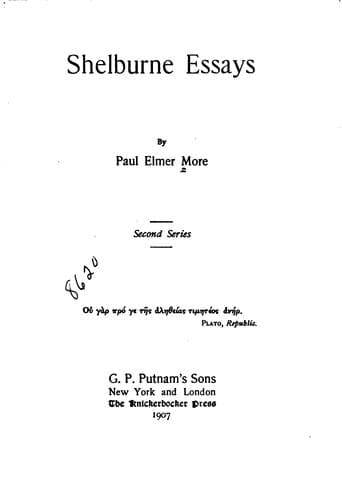
American literature -- History and criticism; English literature -- History and criticism
Enough has been said to indicate the trait of character that prevails
through these pages of eulogy and vituperation. It is not nice to apply
so crass a word as _conceit_ to one who undoubtedly belongs to the
immortals of our pantheon, yet the expression forces itself upon me.
Listen to another of his outbursts, this time against Matthew Arnold:
"His inveterate and invincible Philistinism, his full community of
spirit and faith, in certain things of import, with the vulgarest
English mind!" Does not the quality begin to define itself more exactly?
There is a phrase they use in France, _épater le bourgeois_, of those
artistic souls who contrast themselves by a kind of ineffable contempt
with commonplace humanity, and who take pleasure in tweaking the nose,
so to speak, of the amiable plebeian. Have a care, gentlemen! The
Philistine has a curious trick of revenging himself in the long run. For
my own part, when it comes to a breach between the poetical and the
prosaic, I take my place submissively with the latter. There is at least
a humble safety in retaining one's pleasure in certain things of import
with the vulgarest English mind, and if it were obligatory to choose
between them (as, happily, it is not) I would surrender the wind-swept
rhapsodies of Swinburne for the homely conversation of Whittier.
CHRISTINA ROSSETTI
Probably the first impression one gets from reading the _Complete
Poetical Works_ of Christina Rossetti, now collected and edited by her
brother, Mr. W. M. Rossetti,[6] is that she wrote altogether too much,
and that it was a doubtful service to her memory to preserve so many
poems purely private in their nature. The editor, one thinks, might well
have shown himself more "reverent of her strange simplicity." For page
after page we are in the society of a spirit always refined and
exquisite in sentiment, but without any guiding and restraining artistic
impulse; she never drew to the shutters of her soul, but lay open to
every wandering breath of heaven. In comparison with the works of the
more creative poets her song is like the continuous lisping of an æolian
harp beside the music elicited by cunning fingers. And then, suddenly,
out of this sweet monotony, moved by some stronger, clearer breeze of
inspiration, there sounds a strain of wonderful beauty and flawless
perfection, unmatched in its own kind in English letters. An anonymous
purveyor of anecdotes has recently told how one of these more exquisite
songs called forth the enthusiasm of Swinburne. It was just after the
publication of _Goblin Market and Other Poems_, and in a little company
of friends that erratic poet and critic started to read aloud from the
volume. Turning first to the devotional paraphrase which begins with
"Passing away, saith the World, passing away," he chanted the lines in
his own emphatic manner, then laid the book down with a vehement
gesture. Presently he took it up again, and a second time read the poem
through, even more impressively.
Public-domain text, read in full here on John Shaqi.
Reviews
Reviews
No reviews yet
Be the first to share your thoughts on this work.
Elsewhere in the archive
Join the Discussion
Join the discussion
Sign in to leave a comment or review.
Sign InorCreate an account