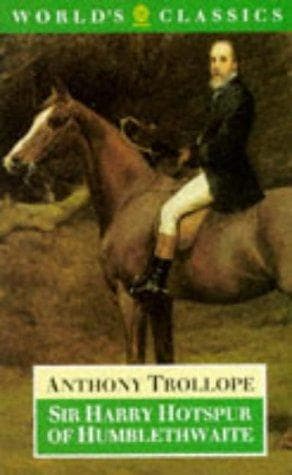
Sir Harry Hotspur of HumblethwaiteTrollope, Anthony
General
Sir Harry Hotspur of Humblethwaite
Trollope, Anthony
Cumberland (England) -- Fiction; Domestic fiction; Fathers and daughters -- Fiction; Inheritance and succession -- Fiction
Poor Lady Elizabeth had not a chance with Cousin George. She
succumbed to him at once, not knowing why, but feeling that she
herself became bright, amusing, and happy when talking to him. She
was a woman not given to familiarities; but she did become familiar
with him, allowing him little liberties of expression which no other
man would take with her, and putting them all down to the score of
cousinhood. He might be a black sheep. She feared there could be but
little doubt that he was one. But, from her worsted-work up to the
demerits of her dearest friend, he did know how to talk better than
any other young man she knew. To Emily, on that first evening, he
said very little. When he first met her he had pressed her hand, and
looked into her eyes, and smiled on her with a smile so sweet that
it was as though a god had smiled on her. She had made up her mind
that he should be nothing to her,--nothing beyond a dear cousin;
nevertheless, her eye had watched him during the whole hour of
dinner, and, not knowing that it was so, she had waited for his
coming to them in the evening. Heavens and earth! what an oaf was
that young Thoresby as the two stood together near the door! She did
not want her cousin to come and talk to her, but she listened and
laughed within herself as she saw how pleased was her mother by the
attentions of the black sheep.
One word Cousin George did say to Emily Hotspur that night, just as
the ladies were leaving the room. It was said in a whisper, with a
little laugh, with that air of half joke half earnest which may be so
efficacious in conversation: "I did not go to Goodwood, after all."
She raised her eyes to his for a quarter of a second, thanking him
for his goodness in refraining. "I don't believe that he is really a
black sheep at all," she said to herself that night, as she laid her
head upon her pillow.
After all, the devil fights under great disadvantages, and has to
carry weights in all his races which are almost unfair. He lies as a
matter of course, believing thoroughly in lies, thinking that it is
by lies chiefly that he must make his running good; and yet every lie
he tells, after it has been told and used, remains as an additional
weight to be carried. When you have used your lie gracefully and
successfully, it is hard to bury it and get it well out of sight.
It crops up here and there against you, requiring more lies; and
at last, too often, has to be admitted as a lie, most usually
so admitted in silence, but still admitted,--to be forgiven or
not, according to the circumstances of the case. The most perfect
forgiveness is that which is extended to him who is known to lie
in everything. The man has to be taken, lies and all, as a man is
taken with a squint, or a harelip, or a bad temper. He has an uphill
game to fight, but when once well known, he does not fall into the
difficulty of being believed.
Public-domain text, read in full here on John Shaqi.
Reviews
Reviews
No reviews yet
Be the first to share your thoughts on this work.
Elsewhere in the archive
Join the Discussion
Join the discussion
Sign in to leave a comment or review.
Sign InorCreate an account