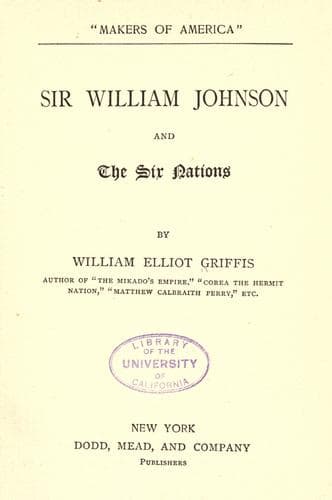
Sir William Johnson and the Six NationsGriffis, William Elliot
History
Sir William Johnson and the Six Nations
Griffis, William Elliot
Johnson, William, 1715-1774; United States -- History -- French and Indian War, 1754-1763
The wily savages now prepared to ambuscade the party which they knew
would soon appear from Schenectady. For this purpose they laid a
sensational trap in a field, somewhat off from the path and in a defile
near the creek, which was surrounded with forest and bush. Taking the
dead body of Mr. Toll, they set it up against a fence and tied a live
crow in front of the corpse. This curious sight of a wild crow flying up
and down before an apparently living man they knew would at once excite
the attention, especially of the impulsive and unwary young men who, as
they supposed, would be the first on the field. The sequel proves they
were not disappointed.
Lieutenant Darling and his Connecticut men marched out, cautiously
searching for the enemy, but seeing no trace of any. At Mr. Simon
Groot’s unoccupied house they found Adrian Van Slyck, who with a few men
had arrived and learned from the negro boy Ryckert, that his master, Mr.
Toll, had been shot. Though nearly paralyzed with fear, he offered to
point out the place where he fell. The negro was furnished with a horse,
and acted as pilot to the advance party of about forty men. Soon after
they had gone, Ackes Van Slyck arrived and remained with his men near
the house.
Pretty soon the strange phenomenon of a crow playing near a man arrested
their attention, and they at once marched into the trap to see the
curious sight. Very soon they discovered that the man was a corpse, and
the crow was tied to it with a string. At this moment when nearly all
were in the defile along the creek, and off their guard, the crash of
the enemy’s guns enlightened them as to the situation. They found
themselves in a ravine or hollow curved like a horseshoe, and nearly
surrounded on both sides by woods, from which puffs of white smoke and
flashes of fire were issuing from unseen enemies. Eight or ten of the
whites were at once stretched dead on the clay ground, and then the
yelling savages leaped out of cover with knife and hatchet.
The militiamen soon broke and ran, but the Schenectady men bravely stood
their ground. It took a moment to deliver their fire, and then with
musket clubbed or thrown aside, the fighting became, for a few minutes,
a series of desperate encounters between white and red man, in which it
happened more than once that both buried their knives in each other.
After the battle the bodies of Glen, De Graaf, and other noted Indian
fighters were found alongside their dead enemies with whom they had
wrested in deadly struggle. In this hand-to-hand fight twelve of the
party of whites were killed, and five made prisoners; Lieutenant
Darling’s company losing seven men, who were shot dead, and six missing.
Public-domain text, read in full here on John Shaqi.
Reviews
Reviews
No reviews yet
Be the first to share your thoughts on this work.
Elsewhere in the archive
Join the Discussion
Join the discussion
Sign in to leave a comment or review.
Sign InorCreate an account