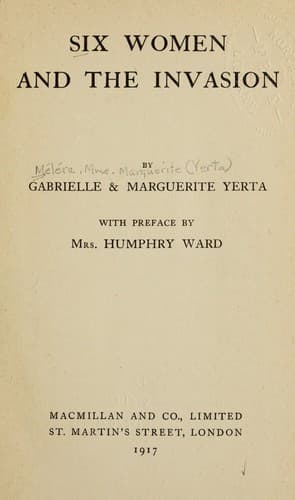
Six Women and the InvasionMéléra, Marguerite-Yerta
History
Six Women and the Invasion
Méléra, Marguerite-Yerta
World War, 1914-1918 -- Personal narratives
And the gossips began to tell their grievances, for many of these
undesirable guests were in truth very hard to please, and their manners
were detestable. They wiped their filthy boots on the beds and
arm-chairs, deluged the carpets and floors with water; they burnt the
furniture and linen with their cigars. They came back very late at
night, generally tipsy, went to the kitchen, searched the larder and
sideboard, and cooked an extra meal with the stolen goods. The mistress
of the house deemed herself very happy when she was not aroused from a
well-earned sleep and ordered to go and rattle about saucepans and
kitchen ranges. Of course, Barbu and Crafleux would have repudiated such
methods with disgust. Barbu and Crafleux piqued themselves on their
gentlemanly manners. Barbu and Crafleux were two model Prussians.
For truth's sake I must admit that occasionally they came home after
midnight amiably drunk, and--I am a credible witness--danced a jig in
the yard. But these are venial sins, and our watch-dogs themselves, who
from the first day had been hand in glove with the officers, looked
indulgently upon such gambols. Gracieuse was even accused of cherishing
a guilty passion for Crafleux, having once been discovered, curled into
a ball, upon the bed of the gentleman aforesaid-a most improper act for
a lady dog brought up never to enter the house. Another fault was
ascribed to Barbu. On the officers' arrival, we had held a secret
meeting to discuss the question of lights. At length we decided to give
one candle to each man, having laid by a box in case of emergency.
The next morning we discovered a scandal unheard of. Barbu ... his
candle ... a virgin candle, a white, shapely candle! The criminal had
burnt it up in a single night! A huge candle which in the present state
of things was worth its weight in gold! A few waxen tears, still hanging
to the socket, bore witness to the poor thing's death. We put in its
stead a dumpy one, whose loss we should not feel so deeply, and after
that he must provide others for himself. He must provide his firing
also. As a matter of fact he did. One day the officers demanded fires in
their rooms.
"Very well, the charwoman will look after it. But ... fuel runs short."
Barbu wrote at once a note of hand, gave it to the smart bustling
sergeant, and the day after ten sacks of coal were brought and
discharged in the coach-house. We gazed at the black heap with envious
eyes, for we used to do our cooking and warm our rooms with a poor
faggot of wood.
The officers very well knew that we lacked all kinds of stores, and
Barbu asked me once in a roundabout way if they might offer us some
petroleum and sugar.
"We have just received an abundant supply," he said, "and shall be
enchanted if you will make use of them."
This was worthy of reflection. We answered at last that we would
gratefully take their proffered goods, on condition that we might pay
for them.
Public-domain text, read in full here on John Shaqi.
Reviews
Reviews
No reviews yet
Be the first to share your thoughts on this work.
Elsewhere in the archive
Join the Discussion
Join the discussion
Sign in to leave a comment or review.
Sign InorCreate an account