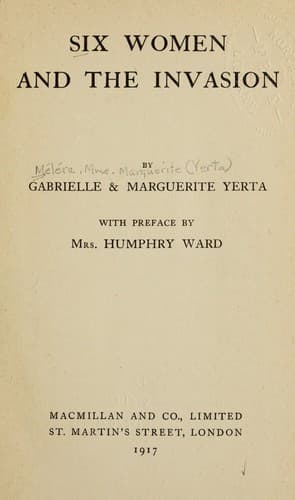
Six Women and the InvasionMéléra, Marguerite-Yerta
History
Six Women and the Invasion
Méléra, Marguerite-Yerta
World War, 1914-1918 -- Personal narratives
However, the departure of our guests set us at ease, and the whole
village along with us. As the village might not revictual itself
officially, it revictualled itself by fraud, and as much as possible.
Now there lives in Morny a sympathetic drunkard named Durand. Fond of
quarrelling as he is in his cups, when in a sober state he is a good,
kindly soul. He had been invalided, because his hands were twisted by
gout, and this infirmity rendered him equally unfit for the work of the
fields; so he became a tradesman. He deals usually in rabbit-skins,
scrap-iron, and rags. His business and stock-in-trade consist of a box
set up on two wheels, and drawn by a good-natured yellow dog. Scrap-iron
may hide a good many things, and with a view to present circumstances
our friend contrived to extend his import trade. Far from me to hint
that Durand, in ordinary times, snaps his fingers at the gendarmes and
laughs at the laws, practices as common in our border departments as
unseemly everywhere. But he improvised with the war a wonderful cunning,
thanks to which he smuggled all sorts of necessary things into Morny,
under the Germans' very eyes. In his surprise packet were concealed
butter, grease, chocolate, sugar, to say nothing of candles. The
housewives scrambled for the provisions, which rose almost to the usual
level. The weary dog put out his tongue and laughed, for he knew well
that we were getting the better of the Germans.
He was not the only one to laugh. The peasants, too, laughed in their
sleeves when they saw the Germans stock still in "the mountains." At the
first moment of invasion, the people were struck with dismay. The
arrogant enemy, sure of victory, seemed to meet with no obstacles.
"Handsome men, well armed and equipped. Ah, there is no reason to laugh
at them!" said the old women. They thought the situation hopeless. But
now it was whispered about, "They won't pass 'the mountains'; they won't
cross the Aisne." At this conviction their hearts rose, which yesterday
had been filled with bitterness. Evidently the invaders had been
stopped; they knew not how, but the fact remained.
Public-domain text, read in full here on John Shaqi.
Reviews
Reviews
No reviews yet
Be the first to share your thoughts on this work.
Elsewhere in the archive
Join the Discussion
Join the discussion
Sign in to leave a comment or review.
Sign InorCreate an account