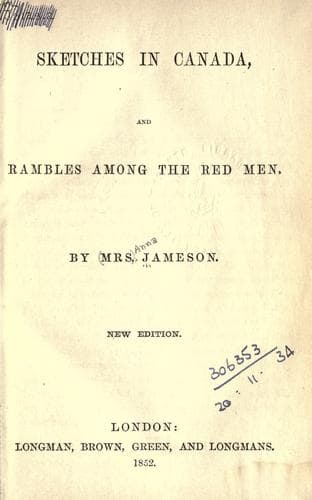
Sketches in Canada, and rambles among the red menJameson, Mrs. (Anna)
History
Sketches in Canada, and rambles among the red men
Jameson, Mrs. (Anna)
Indians of North America -- Canada; Ontario -- Description and travel
I should not forget to mention, that in the Niagara and Gore districts
there is a vast number of Dutch and German settlers, favourably
distinguished by their industrious, sober, and thriving habits. They are
always to be distinguished in person and dress from the British
settlers; and their houses and churches, and, above all, their
burial-places, have a distinct and characteristic look. At Berlin, the
Germans have a printing-press, and publish a newspaper in their own
language, which is circulated among their countrymen through the whole
province.
At Hamilton I hired a light _wagon_, as they call it, a sort of gig
perched in the middle of a wooden tray, wherein my baggage was stowed;
and a man to drive me over to Brandtford, the distance being about
five-and-twenty miles, and the charge five dollars. The country all the
way was rich, and beautiful, and fertile beyond description--the roads
abominable as could be imagined to exist. So I then thought, but have
learned since that there are degrees of badness in this respect, to
which the human imagination has not yet descended. I remember a space of
about three miles on this road, bordered entirely on each side by dead
trees, which had been artificially blasted by fire, or by girdling. It
was a ghastly forest of tall white spectres, strangely contrasting with
the glowing luxurious foliage all around.
The pity I have for the trees in Canada, shows how far I am yet from
being a true Canadian. How do we know that trees do not feel their
downfall? We know nothing about it. The line which divides animal from
vegetable sensibility is as undefined as the line which divides animal
from human intelligence. And if it be true "that nothing dies on earth
but nature mourns," how must she mourn for these the mighty children of
her bosom--her pride, her glory, her garment? Without exactly believing
the assertion of the old philosopher, quoted by Evelyn, that a tree
_feels_ the first stroke of the axe, I know I never witness nor hear the
first stroke without a shudder; and as yet I cannot look on with
indifference, far less share the Canadian's exultation, when these huge
oaks, these umbrageous elms and stately pines, are lying prostrate,
lopped of all their honours, and piled in heaps with the brushwood, to
be fired,--or burned down to a charred and blackened fragment,--or
standing, leafless, sapless, seared, ghastly, having been "girdled," and
left to perish. The "Fool i' the Forest" moralised not more quaintly
over the wounded deer, than I could sometimes over those prostrate and
mangled trees. I remember, in one of the clearings to-day, one
particular tree which had been burned and blasted; only a blackened
stump of mouldering bark--a mere shell remained; and from the centre of
this, as from some hidden source of vitality, sprang up a young green
shoot, tall and flourishing, and fresh and leafy. I looked and thought
of hope! Why, indeed, should we ever despair? Can Heaven do for the
Public-domain text, read in full here on John Shaqi.
Reviews
Reviews
No reviews yet
Be the first to share your thoughts on this work.
Elsewhere in the archive
Join the Discussion
Join the discussion
Sign in to leave a comment or review.
Sign InorCreate an account