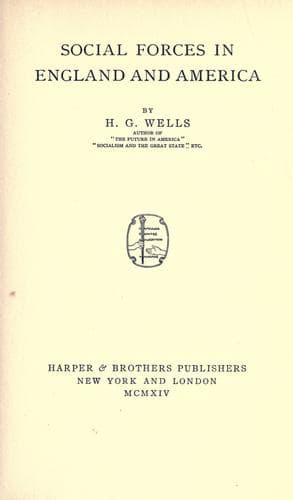
Social Forces in England and AmericaWells, H. G. (Herbert George)
History
Social Forces in England and America
Wells, H. G. (Herbert George)
England -- Social conditions -- 20th century; Social problems; United States -- Social conditions -- 1865-1918
And from the labour class itself we are also justified in demanding a
far more effectual contribution to the National Conference than it is
making at the present time. Mere eloquent apologies for distrust, mere
denunciations of Capitalism and appeals for a Socialism as featureless
as smoke, are unsatisfactory when one regards them as the entire
contribution of the ascendant worker to the discussion of the national
future. The labour thinker has to become definite in his demands and
clearer upon the give and take that will be necessary before they can be
satisfied. He has to realise rather more generously than he has done so
far the enormous moral difficulty there is in bringing people who have
been prosperous and at an advantage all their lives to the pitch of even
contemplating a social reorganisation that may minimise or destroy their
precedence. We have all to think, to think hard and think generously,
and there is not a man in England to-day, even though his hands are busy
at work, whose brain may not be helping in this great task of social
rearrangement which lies before us all.
SOCIAL PANACEAS
(_June, 1912_)
To have followed the frequent discussions of the Labour Unrest in the
Press is to have learnt quite a lot about the methods of popular
thought. And among other things I see now much better than I did why
patent medicines are so popular. It is clear that as a community we are
far too impatient of detail and complexity, we want overmuch to
simplify, we clamour for panaceas, we are a collective invitation to
quacks.
Our situation is an intricate one, it does not admit of a solution
neatly done up in a word or a phrase. Yet so powerful is this wish to
simplify that it is difficult to make it clear that one is not oneself a
panacea-monger. One writes and people read a little inattentively and
more than a little impatiently, until one makes a positive proposal.
Then they jump. “So _that’s_ your Remedy!” they say. “How absurdly
inadequate!” For example, I was privileged to take part in one such
discussion in 1912, and among other things in my diagnosis of the
situation I pointed out the extreme mischief done to our public life by
the futility of our electoral methods. They make our whole public life
forensic and ineffectual, and I pointed out that this evil effect, which
vitiates our whole national life, could be largely remedied by an
infinitely better voting system known as Proportional Representation.
Thereupon the _Westminster Gazette_ declared in tones of pity and
contempt that it was no Remedy—and dismissed me. It would be as
intelligent to charge a doctor who pushed back the crowd about a
broken-legged man in the street with wanting to heal the limb by giving
the sufferer air.
Public-domain text, read in full here on John Shaqi.
Reviews
Reviews
No reviews yet
Be the first to share your thoughts on this work.
Elsewhere in the archive
Join the Discussion
Join the discussion
Sign in to leave a comment or review.
Sign InorCreate an account