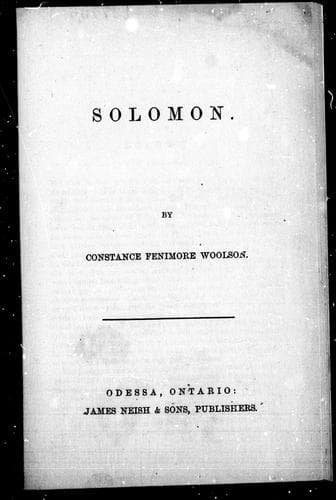
American fiction -- 19th century; Short stories, American
I rowed back in the glow of the evening across the grassy sea. 'It is
beautiful, beautiful,' I thought, 'but it is passing away. Already
commerce has invaded its borders; a few more years and its loveliness
will be but a legend of the past. The bittern has vanished; the loon has
fled away. Waiting Samuel was the prophet of the waste; he has gone, and
the barriers are broken down. No artist has painted, no poet has sung
your wild, vanishing charm; but in one heart, at least, you have a
place, O lovely land of St. Clair!'
THE LADY OF LITTLE FISHING.
It was an island in Lake Superior.
I beached my canoe there about four o'clock in the afternoon, for the
wind was against me and a high sea running. The late summer of 1850, and
I was coasting along the south shore of the great lake, hunting,
fishing, and camping on the beach, under the delusion that in that way I
was living 'close to the great heart of nature,'--whatever that may
mean. Lord Bacon got up the phrase; I suppose he knew. Pulling the boat
high and dry on the sand with the comfortable reflection that here were
no tides to disturb her with their goings-out and comings-in, I strolled
through the woods on a tour of exploration, expecting to find bluebells,
Indian pipes, juniper rings, perhaps a few agates along-shore, possibly
a bird or two for company. I found a town.
It was deserted; but none the less a town, with three streets,
residences, a meeting-house, gardens, a little park, and an attempt at a
fountain. Ruins are rare in the New World. I took off my hat. 'Hail,
homes of the past!' I said. (I cultivated the habit of thinking aloud
when I was living close to the great heart of nature.) 'A human voice
resounds through your arches' (there were no arches,--logs won't arch;
but never mind) 'once more, a human hand touches your venerable walls, a
human foot presses your deserted hearth-stones.' I then selected the
best half of the meeting-house for a camp, and kindled a glorious
bonfire in the park. 'Now that you are illuminated with joy, O Ruin,' I
remarked, 'I will go down to the beach and bring up my supplies. It is
long since I have had a roof over my head; I promise you to stay until
your last residence is well burned; then I will make a final cup of
coffee with the meeting-house itself, and depart in peace, leaving your
poor old bones buried in decent ashes.'
Public-domain text, read in full here on John Shaqi.
Reviews
Reviews
No reviews yet
Be the first to share your thoughts on this work.
Join the Discussion
Join the discussion
Sign in to leave a comment or review.
Sign InorCreate an account