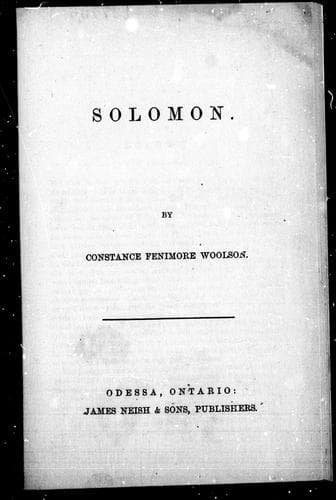
American fiction -- 19th century; Short stories, American
The ruin made no objection, and I took up my abode there, the roof of
the meeting-house was still water-tight (which is an advantage when the
great heart of nature grows wet). I kindled a fire on the sacerdotal
hearth, cooked my supper, ate it in leisurely comfort, and then
stretched myself on a blanket to enjoy an evening pipe of peace,
listening meanwhile to the sounding of the wind through the great
pine-trees. There was no door to my sanctuary, but I had the cosey far
end; the island was uninhabited, there was not a boat in sight at
sunset, nothing could disturb me unless it might be a ghost. Presently a
ghost came in.
It did not wear the traditional gray tarlatan armor of Hamlet's father,
the only ghost with whom I am well acquainted; this spectre was clad in
substantial deer-skin garments, and carried a gun and loaded game-bag.
It came forward to my hearth, hung up its gun, opened its game-bag, took
out some birds, and inspected them gravely.
'Fat?' I inquired.
'They'll do,' replied the spectre, and forthwith set to work preparing
them for the coals. I smoked on in silence. The spectre seemed to be a
skilled cook, and after deftly broiling its supper, it offered me a
share; I accepted. It swallowed a huge mouthful and crunched with its
teeth; the spell was broken, and I knew it for a man of flesh and blood.
He gave his name as Reuben, and proved himself an excellent camping
companion; in fact, he shot all the game, caught all the fish, made all
the fires, and cooked all the food for us both. I proposed to him to
stay and help me burn up the ruin, with the condition that when the last
timber of the meeting-house was consumed, we should shake hands and
depart, one to the east, one to the west, without a backward glance. 'In
that way we shall not infringe upon each other's personality,' I said.
'Agreed,' replied Reuben.
He was a man of between fifty and sixty years, while I was on the sunny
side of thirty; he was reserved, I was always generously affable; he was
an excellent cook, while I--well, I wasn't; he was taciturn, and so, in
payment for the work he did, I entertained him with conversation, or
rather monologue, in my most brilliant style. It took only two weeks to
burn up the town, burned we never so slowly; at last it came to the
meeting house, which now stood by itself in the vacant clearing. It was
a cool September day; we cooked breakfast with the roof, dinner with the
sides, supper with the odds and ends, and then applied a torch to the
framework. Our last camp-fire was a glorious one. We lay stretched on
our blankets, smoking and watching the glow. 'I wonder, now, who built
the old shanty,' I said in a musing tone.
'Well,' replied Reuben, slowly, 'if you really want to know, I will tell
you. I did.'
'You!'
'Yes.'
'You didn't do it alone?'
'No; there were about forty of us.'
'Here?'
'Yes; here at Little Fishing;'
'Little Fishing?'
'Yes; Little Fishing Island. That is the name of the place.'
Public-domain text, read in full here on John Shaqi.
Reviews
Reviews
No reviews yet
Be the first to share your thoughts on this work.
Join the Discussion
Join the discussion
Sign in to leave a comment or review.
Sign InorCreate an account