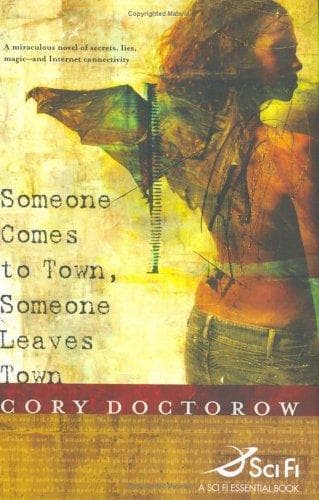
Someone Comes to Town, Someone Leaves TownDoctorow, Cory
Science
Someone Comes to Town, Someone Leaves Town
Doctorow, Cory
Internet -- Fiction; Science fiction; Toronto (Ont.) -- Fiction
And that's what they did, book after book -- old books, hardcover books,
board-back kids' books, new paperbacks, dozens of green- and
orange-spined Penguin paperbacks. He fondled them, smelled them. Some
smelled of fish and chips, and some smelled of road dust, and some
smelled of Marci, and they had dog ears where she'd stopped and cracks
in their spines where she'd bent them around. They fell open to pages
that had her favorite passages. He felt wobbly and drunk as he touched
each one in turn.
"Have you read all of these?" Alan asked as he shifted the John
Mortimers down one shelf to make room for the Ed McBains.
"Naw," she said, punching him in the shoulder. "What's the point of a
bunch of books you've already read?"
#
She caught him in the schoolyard on Monday and dragged him by one ear
out to the marshy part. She pinned him down and straddled his chest and
tickled him with one hand so that he cried out and used the other hand
to drum a finger across his lips, so that his cries came out "bibble."
Once he'd bucked her off, they kissed for a little while, then she
grabbed hold of one of his nipples and twisted.
"All right," she said. "Enough torture. When do I get to meet your
family?"
"You can't," he said, writhing on the pine needles, which worked their
way up the back of his shirt and pricked him across his lower back,
feeling like the bristles of a hairbrush.
"Oh, I can, and I will," she said. She twisted harder.
He slapped her hand away. "My family is really weird," he said. "My
parents don't really ever go out. They're not like other people. They
don't talk." All of it true.
"They're mute?"
"No, but they don't talk."
"They don't talk much, or they don't talk at all?" She pronounced it
a-tall.
"Not at all."
"How did you and your brothers learn to talk, then?"
"Neighbors." Still true. The golems lived in the neighboring caves. "And
my father, a little." True.
"So you have neighbors who visit you?" she asked, a triumphant gleam in
her eye.
*Damn*. "No, we visit them." Lying now. Sweat on the shag of hair over
his ears, which felt like they had coals pressed to them.
"When you were a baby?"
"No, my grandparents took care of me when I was a baby." Deeper. "But
they died." Bottoming out now.
"I don't believe you," she said, and he saw tears glisten in her
eyes. "You're too embarrassed to introduce me to your family."
"That's not it." He thought fast. "My brother. David. He's not well. He
has a brain tumor. We think he'll probably die. That's why he doesn't
come to school. And it makes him act funny. He hits people, says
terrible things." Mixing truth with lies was a *lot* easier. "He shouts
and hurts people and he's the reason I can't ever have friends over. Not
until he dies."
Her eyes narrowed. "If that's a lie," she said, "it's a terrible one. My
Ma died of cancer, and it's not something anyone should make fun of. So,
it better not be a lie."
Public-domain text, read in full here on John Shaqi.
Reviews
Reviews
No reviews yet
Be the first to share your thoughts on this work.
Elsewhere in the archive
Join the Discussion
Join the discussion
Sign in to leave a comment or review.
Sign InorCreate an account