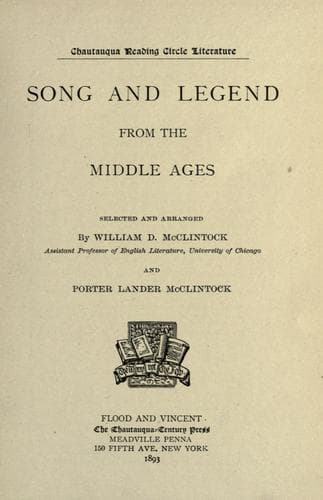
Literature, Medieval -- History and criticism; Literature, Medieval -- Translations into English
After the burial of Siegfried, Kriemhild decides to remain at the
court of Gunther, in the care of her brothers. Thither is brought
the enormous treasures of the Niebelungen, which Siegfried had
won, and of which he had been the guardian, and which now fell to
Kriemhild. The crafty Hagen gains possession of this horde, and
conceals it by sinking it in the Rhine, hoping some day to
recover and enjoy it. For thirteen years Kriemhild remains at the
court of her brother, brooding over her wrongs and meditating
revenge. The second part of the poem begins by telling how
Etzel, king of the Huns, proposed for the hand of the widowed
Kriemhild, and how she finally, hoping to use him in her plan of
vengeance, consents to a marriage with him and goes away with
him into his land. Here for many years she lives the beloved
queen of the Huns. But her purpose of vengeance never falters,
and at last she persuades Etzel to invite her brothers to his
court on a visit. Against many forebodings and warnings they
come, Hagen with them. After numerous interesting episodes upon
the journey, they arrive at Etzell's court and are handsomely
welcomed. But the inevitable quarrel soon breaks out and a
desperate fight begins. After a most desperate and bloody
struggle, Gunther, Hagen, and a few followers are shut up in a
hall. To this Kriemhild sets fire.
THE BURNING OF THE HALL.
Stanza, 2186-2194.
With that, the wife of Etzel had set the hall on fire.
How sore then were they tortur'd in burning anguish dire!
At once, as the wind freshen'd, the house was in a glow.
Never, I ween, were mortals in such extremes of woe.
"We all are lost together," each to his neighbour cried,
"It had been far better we had in battle died.
Now God have mercy on us! woe for this fiery pain!
Ah! what a monstrous vengeance the bloody queen has ta'en!"
Then faintly said another, "needs must we here fall dead;
What boots us now the greeting, to us by Etzel sped?
Ah me! I'm so tormented by thirst from burning heat,
That in this horrid anguish my life must quickly fleet."
Thereat outspake Sir Hagan, the noble knight and good,
"Let each, by thirst tormented, take here a draught of blood.
In such a heat, believe me, 't is better far than wine.
Nought's for the time so fitting; such counsel, friends, is
mine."
With that straight went a warrior, where a warm corpse he found.
On the dead down knelt he; his helmet he unbound;
Then greedily began he to drink the flowing blood.
However unaccustom'd, it seem'd him passing good.
"Now God requite thee, Hagan," the weary warrior cried,
"For such refreshing beverage by your advice supplied.
It has been my lot but seldom to drink of better wine.
For life am I thy servant for this fair hint of thine."
When th' others heard and witness'd with that delight he quaff'd,
Yet many more among them drank too the bloody draught.
It strung again their sinews, and failing strength renew'd.
This in her lover's person many a fair lady rued.
Public-domain text, read in full here on John Shaqi.
Reviews
Reviews
No reviews yet
Be the first to share your thoughts on this work.
Join the Discussion
Join the discussion
Sign in to leave a comment or review.
Sign InorCreate an account