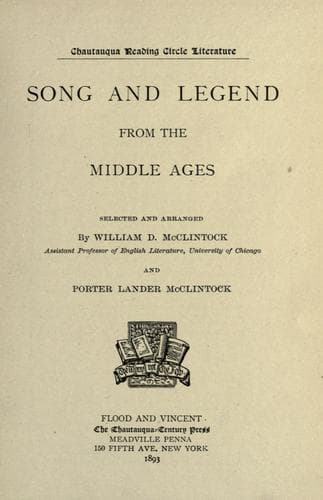
Literature, Medieval -- History and criticism; Literature, Medieval -- Translations into English
Then the cries ceased, and the counter-cries,
And all the battle of advice,
And every lord, being content
With Henry's choice, granted assent.
Then the priests came to bind as one
Two lives in bridal unison,
Into his hand they folded hers,
Not to be loosed in coming years,
And uttered between man and wife
God's blessing on the road of this life.
Many a bright and pleasant day
The twain pursued their steadfast way,
Till hand in hand, at length they trod
Upward to the kingdom of God.
Even as it was with them, even thus,
And quickly, it must be with us.
To such reward as theirs was then,
God help us in His hour. Amen.
-- Tr. by Rossetti.
THE MINNESINGERS.
In the twelfth century, Germany had a remarkable outburst of
lyric poetry, chiefly songs of love. The influence of the
crusades, the spread of the romances of Arthur and Charlemagne
roused over all Germany the spirit of poetry. The poets of this
new movement are called Minnesingers. It is interesting to notice
that the same poets who wrote these love lyrics, wrote also long
romances of chivalry; the greatest names among them being
Hartmann von Aue, Wolfram von Eschenbach, Heinrich von
Ofterdingen, Gottfried von Strassburg, and Walther von der
Vogelweide. They were of all ranks, but chiefly belonged to the
upper classes--knights, squires, princes, and even kings being
numbered among them. Their extraordinarily large number may be
gathered from the fact that from the twelfth century alone the
names of one hundred and sixty Minnesingers have come down to us.
Their names and their songs have been handed down largely by
tradition, since the mass of them could neither read nor write,
and for a century or more their work was preserved orally.
The subject of these songs was almost always love--generally love
of a sweetheart; sometimes of the simpler aspects of nature,
sometimes the love of the Virgin. Besides this they wrote also
many didactic, religious, and patriotic songs. The rhythmical and
metrical structure of their verse was very complicated and
generally very skillful, sometimes, however, running into
eccentricities and barren technicalities. The Minnesinger
generally composed the music of his song at the same time with
the verse.
Public-domain text, read in full here on John Shaqi.
Reviews
Reviews
No reviews yet
Be the first to share your thoughts on this work.
Join the Discussion
Join the discussion
Sign in to leave a comment or review.
Sign InorCreate an account