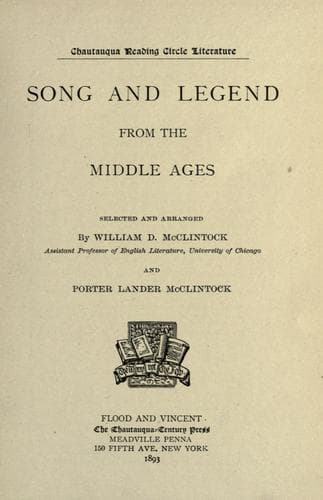
Literature, Medieval -- History and criticism; Literature, Medieval -- Translations into English
Stanza 59.--
Thou cool, thou cold, thou warmth, thou heat,
Thou rapture's circle's central seat,
Who does not meet
With thee stays dead in sadness;
Each day to him appears a year,
Seldom his thoughts wear green bloom's gear;
He doth appear
Forever without gladness.
Thou art most truly our heart's shine
Our sun wide joy-inspiring;
A sweet heart's love for all that pine,
For all the sad a joyful shrine,
A spring divine
For the thirsty and desiring.
--Tr. by Kroeger.
CHAPTER V. ITALIAN LITERATURE.
There was no folk poetry and no popular literature in Mediaeval
Italy. There were two reasons for this: (1) Italian history,
political and intellectual, attaches itself very closely to that
of Rome. The traditions of classic learning never died out. Hence
the Italian nation was always too learned, too literary to
develop a folk literature. (2) Italy was for many centuries
dominated by ecclesiastical influence, and the people's minds
were full of matters of religious and scholastic philosophy,
which excluded art.
The Italians translated and adapted some of the epics, romances,
and tales of other countries, during the earlier years of the
Middle Ages; but they were written in Latin, or in a kind of
French. They produced none of their own. There was no literature
written in Italian before the thirteenth century.
In the thirteenth century (1250) there came the first outburst of
Italian literature--religious songs, love songs, dramas, and
tales. In almost every part of Italy men began to write. But it
was in Tuscany, in Florence, that the most remarkable literary
development of this period appeared. It was of the nature chiefly
of lyric and allegoric poetry. The work of this group of Tuscan
poets was really the beginning of Italian literary art. Yet it
was a finished art product, not at all like the beginnings of
poetry in other countries.
The group numbered a dozen poets of considerable power and skill.
The greatest of them and the greatest of Italian poets was Dante
Alighieri. In Italian mediaeval literature three names stand out
far above all others. They are Dante, Petrarch, and Boccaccio. So
completely do they overshadow their contemporaries, that in
making our selection of Italian literature we shall confine
ourselves entirely to these three.
Dante Alighieri was born at Florence, in May, 1266, and died at
Ravenna in September, 1321. He had an eventful and pathetic life.
He was much in public affairs. He was banished from his native
city in 1302, and died in exile. His literary work is represented
chiefly by the following titles: "Vita Nuova, The New Life";
"Convito, The Banquet"; "De Monarchia, A Treatise on Monarchy";
"De Vulgari Eloquio, A Treatise on the Vulgar Tongue"; and
"Divina Commedia", his masterpiece and the master-work of the
Middle Ages.
FROM THE VITA NUOVA.
Public-domain text, read in full here on John Shaqi.
Reviews
Reviews
No reviews yet
Be the first to share your thoughts on this work.
Elsewhere in the archive
Join the Discussion
Join the discussion
Sign in to leave a comment or review.
Sign InorCreate an account