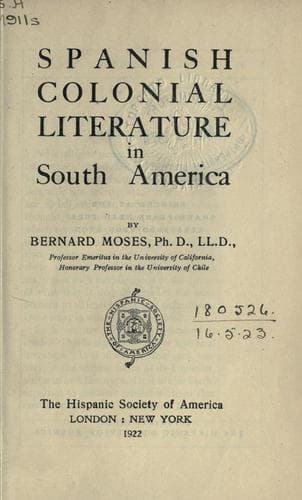
Spanish colonial literature in South AmericaMoses, Bernard
History
Spanish colonial literature in South America
Moses, Bernard
Spanish American literature -- History and criticism
succeeding in this, they should divide the territory of Don Francisco
between them; and after this they swore on the consecrated Host not
to oppose one another. And some say that Almagro swore to abandon all
interest in Cuzco and in the region for a hundred and twenty leagues
farther south although his Majesty might concede it to him, and he took
a solemn oath, saying, ‘If I shall break this oath, may it please thee,
O Lord, to curse me body and soul.’ Having made this agreement and taken
this oath, Don Diego made his preparations and started on his expedition
with more than five hundred men who followed him, and the governor
returned to Lima.”
VII
[Sidenote: Cieza de León in the rush for America]
In the third and fourth decades of the sixteenth century the desire for
adventure in the New World moved many persons to emigrate from Spain.
Well-founded reports that had been made public awakened a profound
interest in America, and when to these reports there were added wildly
extravagant tales of rich principalities there that might be plundered,
a wave of excitement swept members of all classes towards the port of
departure. Men of birth and cultivation were in the race with ignorant
and rough adventurers. Diego de Alvarado, Garcilaso de la Vega, and
Lorenzo de Aldana represented the first of these classes, but the
majority of the other class were, in many cases, men of disappointed
ambitions or such persons as usually yield to the allurements of newly
discovered mines of gold. Among the emigrants of this time was Pedro
Cieza de León, a boy of thirteen or fourteen years of age. Like many
others of his time, he left no record of his origin, save that he was
born in the town of Llerena in Estremadura. Even the fleet with which
he sailed is not positively known; but it is probable that he went with
Rodrigo Durán, who left Cadiz in 1534, and entered the bay of Cartagena
in November of that year. Three years later Cieza de León was at the
town of San Sebastian on the gulf of Darien. In this year 1538, now
nineteen years old, he was a private soldier in the force of four hundred
Spaniards organized by Pedro Vadillo for the campaign up the valley of
the Atrato.
[Sidenote: Vadillo’s Expedition]
Public-domain text, read in full here on John Shaqi.
Reviews
Reviews
No reviews yet
Be the first to share your thoughts on this work.
Join the Discussion
Join the discussion
Sign in to leave a comment or review.
Sign InorCreate an account