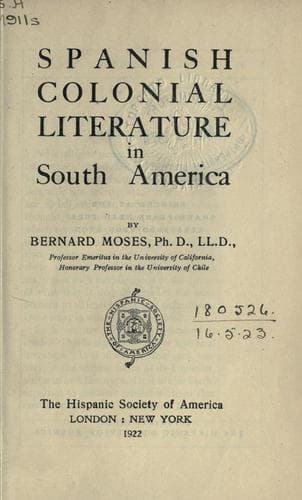
Spanish colonial literature in South America — John Shaqi
Spanish colonial literature in South AmericaMoses, Bernard
History
Spanish colonial literature in South America
Moses, Bernard
Spanish American literature -- History and criticism
[Sidenote: Almagro-Pizarro compact]
[Sidenote: Almagro goes to Chile]
His style is less clear than that of some of his contemporaries, but his
opportunities for gaining information enabled him to present abundant
details of events within the period of his narrative. The following
illustrative extract is from the thirteenth chapter of the second
book. The person referred to as governor was, of course, Francisco
Pizarro: “Diego de Almagro and Pedro de Alvarado[23] having arrived at
Pachacamac, the governor, who had come there from Jauja, received them
good-humouredly, and paid to Don Pedro the one hundred thousand pesos
which he had agreed to give him for his military equipment, although
by many persons he was advised not to pay that sum, affirming that the
equipment was not worth fifty thousand, and that Don Diego had made that
agreement under the constraint of fear of breaking with Don Pedro, for
whom it was very advantageous, and that it would be better to send him a
prisoner to his Majesty; and although the governor might have done that
very easily and without danger, he wished to carry out the promise of Don
Diego de Almagro, his colleague, and he paid him freely the one hundred
thousand pesos in good coins which he allowed him to take with him to
his territory of Guatemala, and Pizarro remained in Peru establishing
the city of Lima, transferring thither the population that had been
settled at Jauja, for the new site appeared to him more suitable and
better adapted to all kinds of business, as it was a seaport. From there
Don Diego went to Cuzco with a great number of persons, and the governor
went down to Trujillo to reorganise the town and distribute the land. And
there he learned that Don Diego de Almagro had wished to lead the city of
Cuzco to revolt, for he had become aware that his majesty, with the news
brought by Hernando Pizarro to him, had granted him a hundred leagues
more of territory beyond the limits of Francisco Pizarro’s territory,
which it was said did not extend quite to the city of Cuzco. Against
this view Juan Pizarro and Gonzalo Pizarro, brothers of the governor,
with a large number of others who joined them, protested, and every day
they were in conflict with Don Diego and with Captain Soto, who was
one of his adherents; but at last he was not able to go out with him,
for the majority of the cabildo took the side of the governor and his
brothers. And when the governor was informed of the state of affairs he
went immediately to Cuzco, and by his presence quieted everything, and
pardoned Don Diego, who was greatly moved by what he had done without
having either title or provision for it, save that they had told him it
had been conceded to him. And they formed a new agreement and company
in this manner, that Don Diego de Almagro should go on an expedition of
discovery by land towards the south, and that if he should find a good
country, he might ask the territory of His Majesty for himself, and, not
Public-domain text, read in full here on John Shaqi.
Reviews
Reviews
No reviews yet
Be the first to share your thoughts on this work.
Join the Discussion
Join the discussion
Sign in to leave a comment or review.
Sign InorCreate an account