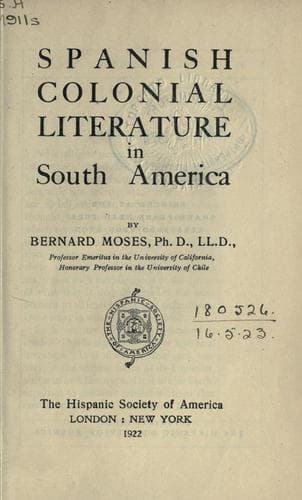
Spanish colonial literature in South AmericaMoses, Bernard
History
Spanish colonial literature in South America
Moses, Bernard
Spanish American literature -- History and criticism
“Some of the most learned of the people were chosen to make known the
lives of those lords in songs, and the events of their reigns, with the
object I have already described. And it is also to be noted that besides
this, it was the custom among them, and a law much kept and observed, for
each king, during his reign, to select three or four old men, known for
their intelligence and ability, who were instructed to retain in their
memory all the events that happened in the provinces, whether they were
prosperous or whether they were the reverse, and to compose songs to be
handed down, so that the history of the reign might be had in remembrance
in after times. But these songs could not be recited or made public,
except in the presence of the lord, and those who were charged with this
duty, during the reign of the king, were not allowed to say anything
which referred to him. But after his death they spoke to his successor
in the empire, almost in these very words: ‘Oh, great and powerful Inca,
the Sun, the Moon, the earth, the hills and the trees, the stones, and
thine ancestors, may they all preserve thee from misfortune and make thee
prosperous, happy, and successful over all that are born. Know that the
events which occurred in the days of thy fathers are these.’ Then in the
narration, they stood in great humility, with eyes cast on the ground and
hands lowered. They could very well do this for there were among them
some men with very good memories, sound judgments, and subtle genius, and
full of reasoning power, as we bear witness, who have heard them even in
these our days.
“As soon as the king understood what was related to him, he caused other
aged men to be called, and charged them with the duty of learning the
songs which were handed down from memory, and to prepare others touching
the events which might occur in his own reign.”
[Sidenote: _Guerra de Quito_]
Besides these works dealing with his travels and the history and
institutions of the Inca kingdom, Cieza de León wrote a history of the
conquest and the civil wars of Peru. Only a part of this work has been
published, the first part of the _Guerra de Quito_, edited by Jiménez de
la Espada. This was printed in Madrid in 1877. The fate of the rest of
the manuscript is unknown. The part here published is the third book
of the Civil Wars of Peru, and gives an account of the conflict between
Gonzalo Pizarro and Blasco Núñez Vela near the city of Quito. It opens
with the departure of Blasco Núñez Vela from San Lucar in Spain to assume
his duties as the first viceroy of Peru. It describes the journey of
the viceroy and his arrival in Peru, the effect of the introduction of
the New Laws, the appeal to Gonzalo Pizarro to become the leader of the
revolt against the viceroy, the reception of Núñez Vela at Lima, and the
course of the rebellion until a short time before the triumph of Gonzalo
Pizarro and the death of the viceroy near Quito.[27]
[Sidenote: Cieza de León’s plan]
Public-domain text, read in full here on John Shaqi.
Reviews
Reviews
No reviews yet
Be the first to share your thoughts on this work.
Join the Discussion
Join the discussion
Sign in to leave a comment or review.
Sign InorCreate an account