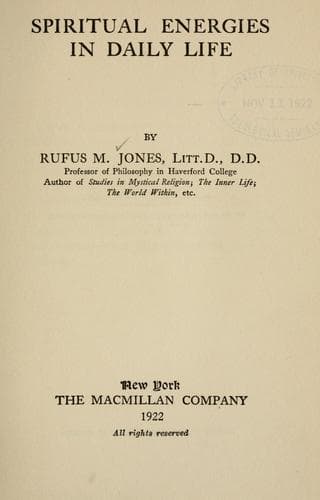
Spiritual Energies in Daily LifeJones, Rufus M. (Rufus Matthew)
Religion
Spiritual Energies in Daily Life
Jones, Rufus M. (Rufus Matthew)
Spiritual life
During one of the intense persecutions by which an early Roman emperor
harried the Christians of the first century, some unknown writer (Harnack
thinks It was a woman) wrote an extraordinary little book to hearten
those who were undergoing the trial of their faith. I mean, of course,
the Epistle to the Hebrews. It is marked by rare genius and by undoubted
inspiration. It is full of vital messages and it contains passages of
great power. Just before the most loved section of the little book—the
account of the faith-heroes—the author, in a passage open to a variety
of translations, refers to the fact that those to whom he is writing
have suffered, and have suffered joyfully, the spoiling of their
possessions, “knowing,” he says, “that you have your own selves for a
better possession”—you yourselves are a better possession than any of
those goods which you have lost for your faith.
I wonder if the readers fully realized the truth, or if we should to-day
realize it had we suffered a similar stripping. We are very slow to take
account of that type of stock. We are very keen about our own assets,
but we often fail to prize this supreme ownership, the possession of
ourselves. There is a story, both sad and amusing, of an insane man who
was seen wildly rushing about the house, from room to room, looking in
cupboards and clothes-presses, crawling under beds, obviously searching
for something. When questioned as to what he was so frantically looking
for, he replied, “I am trying to find my self!” It is not as mad as it
seems. I am not sure but that we who are not trying to find ourselves are
after all more crazy still.
Old Burton, who wrote _The Anatomy of Melancholy_, well said:
“Men look to their tools; a painter will wash his pencils; a
smith will look to his hammer, anvil, and forge; a husbandman
will mend his plow-irons and grind his hatchet, if it be dull;
a musician will string and unstring his lute; only scholars
neglect that instrument, their brains and spirits I mean, which
they daily use.”
Not scholars only, but all classes and conditions of men are guilty
of this strange insanity. If the Duke of Westminster should offer to
transfer to us his estates, we would rush with all conceivable speed to
acquire our new potential possessions. We would go as with wings of an
aeroplane to get the transaction accomplished before anything could occur
to keep us from entering into our fortune. But here we are already within
reach of a vastly better possession, of which we are strangely negligent.
If it came to a choice between himself and his outward possessions, this
duke who owns so much would not hesitate a minute which to prefer. If in
a crisis of illness he could save himself by surrender of his goods, they
would instantly go. “Give me health and a day,” Emerson said, “and I will
make the pomp of emperors ridiculous.”
Public-domain text, read in full here on John Shaqi.
Reviews
Reviews
No reviews yet
Be the first to share your thoughts on this work.
Join the Discussion
Join the discussion
Sign in to leave a comment or review.
Sign InorCreate an account