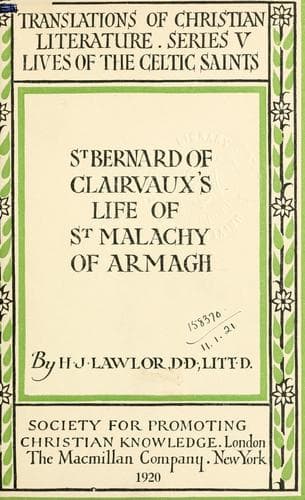
St. Bernard of Clairvaux's Life of St. Malachy of ArmaghBernard, of Clairvaux, Saint
History
St. Bernard of Clairvaux's Life of St. Malachy of Armagh
Bernard, of Clairvaux, Saint
Malachy, Saint, 1094?-1148
6. (4) From this time onwards the Levite[205] of the Lord publicly
girded himself to every work of piety, but more especially to those
things in which there seemed some indignity. In fact it was his greatest
care to attend to the burial of the dead poor,[206] because that
savoured not less of humility than of humanity. Nor did _temptation_
fail to test our modern Tobit,[207] and, as in the old story, it came
from a woman,[208] or rather from the serpent through a woman.[209] His
sister,[210] abhorring the indignity (as it seemed to her) of his
office, said: "What are you doing, madman? _Let the dead bury their
dead._"[211] And she attacked him daily with this _reproach_.[212] But
he _answered the foolish_ woman _according to her folly_,[213] "Wretched
woman, you preserve the sound of the _pure word_,[214] but you are
ignorant of its force." So he maintained with devotion, and exercised
unweariedly the ministry which he had undertaken under compulsion. For
that reason also they[215] deemed that the office of the priesthood
should be conferred upon him. And this was done. But when he was
ordained priest he was about twenty-five years old.[216] And if in both
his ordinations the rule of the Canons seems to have been somewhat
disregarded--as indeed does seem to have been the case, for he received
the Levitical ministry before his twenty-fifth, and the dignity of the
priesthood before his thirtieth year[217]--it may well be ascribed to
the zeal of the ordainer and the merits of him who was ordained.[218]
But for my part, I consider that such irregularity should neither be
condemned in the case of a saint, nor deliberately claimed by him who is
not a saint. Not content with this the bishop also committed to him his
own authority[219] _to sow the_ holy _seed_[220] in a _nation_ which was
not _holy_,[221] and to give to a people rude and living _without
law_,[222] the law of life and of discipline. He received the command
with all alacrity, even as he was _fervent in spirit_,[223] not
hoarding up his talents, but eager for profit from them.[224] And
behold he began to _root out_ with the hoe of the tongue, _to destroy_,
_to scatter_,[225] day by day making _the crooked straight and the rough
places plain_.[226] _He rejoiced as a giant to run_ everywhere.[227] You
might call him a consuming _fire_ burning _the briers_ of crimes.[228]
You might call him _an axe_ or _a mattock casting down_[229] evil
plantings.[230] He extirpated barbaric rites, he planted those of the
Church. All out-worn superstitions (for not a few of them were
discovered) he abolished, and, wheresoever he found it, every sort of
malign influence _sent by evil angels_.[231]
Public-domain text, read in full here on John Shaqi.
Reviews
Reviews
No reviews yet
Be the first to share your thoughts on this work.
Elsewhere in the archive
Join the Discussion
Join the discussion
Sign in to leave a comment or review.
Sign InorCreate an account