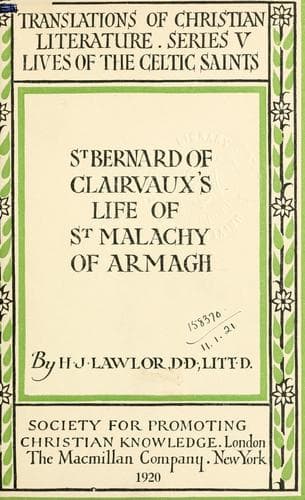
St. Bernard of Clairvaux's Life of St. Malachy of ArmaghBernard, of Clairvaux, Saint
History
St. Bernard of Clairvaux's Life of St. Malachy of Armagh
Bernard, of Clairvaux, Saint
Malachy, Saint, 1094?-1148
[179] His name was Imar (§ 5). He was no doubt Imar O'Hagan, who
founded the monastery of St. Paul and St. Peter at Armagh, and built a
stone church for it which was consecrated on October 21, 1126. It was
placed, either at its foundation or subsequently, under the rule of
the regular canons of St. Augustine. Imar died on pilgrimage at Rome
in 1134, and is commemorated in Gorman on August 13, and in Usuard on
November 12. He was at this time evidently leading the life of an
anchoret. Reeves (_Churches_, p. 28) inferred from his Christian name
that he had some Danish blood in his veins. There is no certain
indication of Malachy's age when he became his disciple. But he had
reached adolescence (§ 3), and was old enough to choose his own
teachers (§ 2). In 1112 he was seventeen years of age. We shall see
that he long acknowledged Imar as his master: §§ 5, 6, 8, 12, 14, 16.
[180] 1 Cor. ix. 27 (vg.).
[181] That is, apparently, the great stone church (_daimliac mór_), on
which Cellach put a shingle roof in 1125. According to Reeves
(_Churches_, pp. 14, 28) it was probably on the site of the present
Cathedral, from which the Abbey of St. Paul and St. Peter was distant
130 yards to the north. It was the principal church of Armagh till
1268. For an account of the life of such recluses as Imar the reader
may be referred to B. MacCarthy, _Codex Palatino-Vaticanus No. 830_,
p. 5 f.
[182] Luke ii. 37.
[183] _Formam._ The word, as used by St. Bernard, seems to include the
two notions of rule and example. It would seem that Malachy received
some sort of monastic rule from Imar. Cp. § 7, "his monastery," and
the reference to "the first day of his conversion" in § 43. Both
passages imply that he belonged to a religious order. So in § 5 he is
said to have been before the other disciples of Imar "in conversion."
On later occasions he was subject to Imar's "command" (§§ 14, 16). It
is not improbable that the disciples who gathered round Imar were the
nucleus of the community which he founded at Armagh (note 1). If so,
the inference is reasonable that Malachy became a regular canon of St.
Augustine.
[184] Matt. xi. 29.
[185] Cp. 2 Tim. iv. 3.
[186] Matt. xv. 14.
[187] Isa. liv. 13; John vi. 45.
[188] 1 Cor. iv. 3.
[189] Gal. i. 11, 12.
[190] Gal. ii. 2.
[191] Printed text, _hoc scit_. I read _sit_ with K (_hec sit_), and
two of de Backer's MSS.
[192] Luke ii. 35.
[193] Lam. iii. 27, 28 (inexact quotation).
[194] Heb. v. 8.
[195] The rule of silence was very strictly observed by the
Cistercians. This explains the stress laid by St. Bernard, here and
elsewhere, on Malachy's practice. Cp. the Preface of Philip of
Clairvaux to _V.P._ vi.: "In truth I have learned nothing that can
more effectively deserve the riches of the grace of the Lord than to
sit and be silent, and always to condescend to men of low estate."
[196] Isa. xxxii. 17 (vg.).
[197] Ps. cxix. 141 (vg.).
[198] Lam. iii. 28.
[199] John i. 14, 18.
[200] Rom. viii. 29.
Public-domain text, read in full here on John Shaqi.
Reviews
Reviews
No reviews yet
Be the first to share your thoughts on this work.
Elsewhere in the archive
Join the Discussion
Join the discussion
Sign in to leave a comment or review.
Sign InorCreate an account