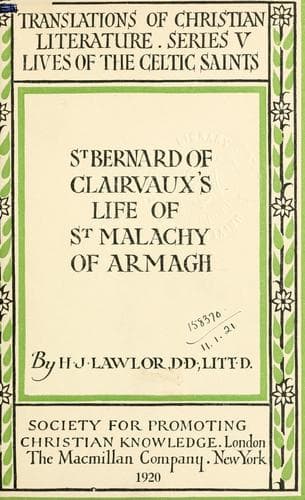
St. Bernard of Clairvaux's Life of St. Malachy of ArmaghBernard, of Clairvaux, Saint
History
St. Bernard of Clairvaux's Life of St. Malachy of Armagh
Bernard, of Clairvaux, Saint
Malachy, Saint, 1094?-1148
[235] Malachy acted in accordance with the aims of Gilbert, bishop of
Limerick, who about the year 1108, wrote these words (_De Usu
Ecclesiastico_, in Ussher, 500): "I have endeavoured to describe the
canonical custom in saying the hours and performing the office of the
whole ecclesiastical order ... to the end that the various and
schismatical orders, with which almost the whole of Ireland has been
deluded, may give place to the one Catholic and Roman office."
[236] Armagh.
[237] This was probably the monastery of SS. Peter and Paul. See p.
11, n. 5. J. de Backer's suggestion (_AA.SS._, Nov. ii. 1, p. 147),
that "his monastery" was Bangor is negatived by the whole context,
which refers only to Armagh.
[238] The word "anew" (_de nouo_) seems to indicate St. Bernard's
belief that it was only in comparatively recent times that the usages
to which he refers had fallen into desuetude.
[239] It is interesting to observe that Confession is here not ranked
as a sacrament.
[240] For the statements in this section see Additional Note A.
[241] Mael Isa Ua hAinmire, who is always called Malchus in Latin
documents, though a native of Ireland, had been a monk of Winchester,
as we are here told. He was elected first bishop of the Danish colony
of Waterford in 1096, and was consecrated by Anselm, assisted by the
bishops of Chichester and Rochester, at Canterbury on December 28,
having previously made his profession of obedience to the archbishop
as one of his suffragans (Eadmer, p. 76 f.; Ussher, pp. 518, 565). He
signed the Acts of the Synod of Rathbreasail in 1110 as archbishop of
Cashel (Keating, iii. 307). He had probably been translated to that
see shortly after its foundation in 1106 (see below, p. 65, n. 4). The
Synod of Rathbreasail enlarged the Danish diocese of Waterford by
adding to it an extensive non-Danish area, which included the ancient
religious site of Lismore, on which St. Carthach or Mochuta had
founded a community in the early part of the seventh century (Lanigan,
ii. 353). The Synod decreed that the see of this diocese should be
either at Lismore or at Waterford, apparently giving preference to the
former (see p. xlvii). It would seem that after organizing the diocese
of Cashel Malchus retired to his former "parish," just as at a later
date Malachy retired from Armagh to Down (§ 31), placing his see at
Lismore. There, at any rate, he was established when Malachy visited
him, and there he died in 1135 "after the 88th year of his pilgrimage"
(_A.F.M._). An attempt has been made to distinguish Mael Isa Ua
hAinmire from the Malchus of the text (Lanigan, iv. 74), but without
success. It is interesting to observe that both _A.F.M._ and _A.T._
style him bishop of Waterford in the record of his death.
[242] Gen. xxxv. 29; 1 Chron. xxiii. 1; Job xlii. 16.--Malchus was in
his 75th year when Malachy visited him in 1121. See preceding note,
and p. 20, n. 3.
[243] 1 Kings iii. 28.
Public-domain text, read in full here on John Shaqi.
Reviews
Reviews
No reviews yet
Be the first to share your thoughts on this work.
Elsewhere in the archive
Join the Discussion
Join the discussion
Sign in to leave a comment or review.
Sign InorCreate an account