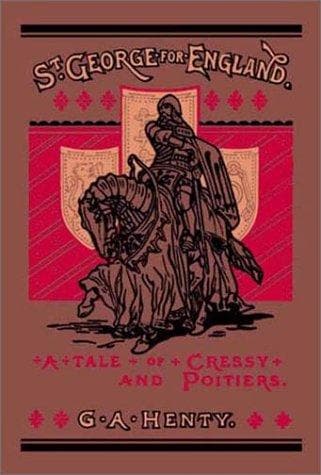
St. George for EnglandHenty, G. A. (George Alfred)
History
St. George for England
Henty, G. A. (George Alfred)
Great Britain -- History -- Edward III, 1327-1377 -- Fiction
Walter was in the highest spirits. A brilliant career was open to him
under the most favourable circumstances; he had already distinguished
himself, and had gained the attention of the highest personages in the
realm, his immediate lord was one of the bravest and most chivalrous
knights in Europe, and he had to sustain and encourage him the hopes
that Lady Vernon had given him, of regaining some day the patrimony of
his father. It was a satisfaction to him that he was as well born as
those who surrounded him, and his purse was well lined as any in the
company. Although he had spent the largess which had been bestowed upon
him at the tournament in procuring clothes fitted for his rank, he was
yet abundantly supplied with money, for both Geoffrey Ward and Giles
Fletcher, having no children of their own and being both well-to-do men,
had insisted upon his accepting a sum which would enable him to make a
good appearance with the best.
A large number of squires followed the banner of Sir Walter Manny. The
records of the time show that the barons were generally accompanied in
the field by almost as many squires as men-at-arms. The former were men
of good family, sons of knights and nobles, aspirants for the honour of
knighthood, and sons of the smaller gentry. Many were there from pure
love of a life of excitement and adventure, others in fulfilment of the
feudal tenure by which all land was then held, each noble and landowner
being obliged to furnish so many knights, squires, men-at-arms, and
archers, in accordance with the size of his holding. The squires fought
in the field in the front rank of the men-at-arms, save those who, like
Walter, were attached to the person of their leader, and who in the
field fought behind him or bore his orders to the companies under his
banner.
In the field all drew pay, and it may be interesting in the present
day to know what were the rates for which our forefathers risked their
lives. They were as follows: each horse archer received 6 deniers, each
squire 12 deniers or 1 sol, each knight 2 sols, each knight banneret 4
sols. 20 sols went to the pound, and although the exact value of money
in those days relative to that which it bears at the present time is
doubtful, it may be placed at twelve times the present value. Therefore
each horse archer received an equivalent to 6s. a day, each squire 12s.,
each knight 24s., and each knight banneret 48s. per day.
Public-domain text, read in full here on John Shaqi.
Reviews
Reviews
No reviews yet
Be the first to share your thoughts on this work.
Join the Discussion
Join the discussion
Sign in to leave a comment or review.
Sign InorCreate an account