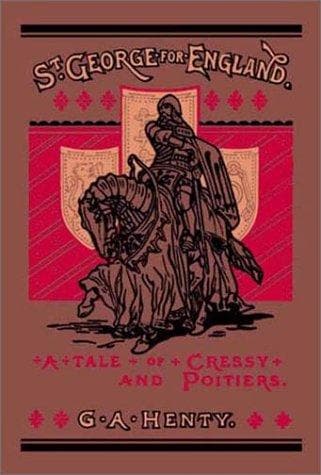
St. George for EnglandHenty, G. A. (George Alfred)
History
St. George for England
Henty, G. A. (George Alfred)
Great Britain -- History -- Edward III, 1327-1377 -- Fiction
In a day or two the whole of the French army came up, and the siege
commenced. Sir John Powis, at his own request, was posted with his men
for the defence of a portion of the wall which was especially open to
the assaults of the enemy. These soon commenced in earnest, and the
Genoese and Spanish mercenaries endeavoured to carry the place by
assault. Sometimes one point would be attacked, at others points far
distant. Covered by the fire of the French crossbowmen, the Spaniards
and Germans came on to the assault, carrying ladders, with which they
strove to climb the walls, but the defenders plied them so vigorously
with quarrels from their cross-bows and flights of arrows that they
frequently desisted before reaching the walls. When they pushed on, and
strove to ascend, their luck was no better. Great stones were hurled
down, and boiling oil poured upon them. The ladders were flung back, and
many crushed by the fall, and in none of the assaults did they gain any
footing in the town. Machines were used, but these were not sufficiently
powerful to batter down the walls, and at the end of April the city was
as far from being captured as it was on the day of the commencement of
the siege.
Walter bore his full share in the fighting, but he had no opportunity
of especially distinguishing himself, although Sir John several times
commended him for his coolness when the bolts of the crossbow-men and
the stones from the machines were flying most thickly. But although as
yet uninjured by the enemy's attacks, the prospect of the city holding
out was not bright. The burghers, who had at first fought valiantly,
were soon wearied of the strife, and of the hardships it entailed upon
them. The siege had continued but a short time when they began to murmur
loudly. The force under the command of the governor was but a small
one, and it would have been impossible for him to resist the will of
the whole population. For a time his exhortations and entreaties were
attended with success, and the burghers returned to their positions on
the walls; but each time the difficulty became greater, and it was
clear to Caddoudal and Sir John Powis that ere long the citizens would
surrender the place in spite of them. The English knight was furious at
the cowardliness of the citizens, and proposed to the governor to summon
twenty of the leading burghers, and to hang them as a lesson to the
others; but the governor shook his head.
“I have but two hundred men on whom I can rely, including your
following, Sir John. We could not keep down the inhabitants for an hour;
and were we to try to do so, they would open the gates and let in the
French. No; I fear that we must await the end.”
The following morning Sir John was awoke with the news that in the night
Caddoudal had been seized and thrown into prison by the burghers, and
that a deputation of citizens had already gone out through the gate to
treat with the Duke of Normandy for the surrender of the city.
Public-domain text, read in full here on John Shaqi.
Reviews
Reviews
No reviews yet
Be the first to share your thoughts on this work.
Elsewhere in the archive
Join the Discussion
Join the discussion
Sign in to leave a comment or review.
Sign InorCreate an account