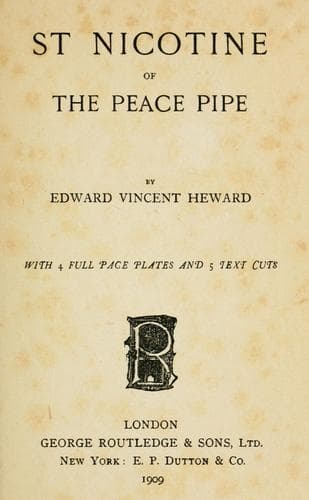
St Nicotine of the Peace PipeHeward, Edward Vincent
History
St Nicotine of the Peace Pipe
Heward, Edward Vincent
Smoking; Tobacco
There is a fourth variety named _Nicotiana Finis_, which has found much
favour in the private gardens of England. It is not so symmetrical as
those just mentioned, its leaves are small, widely separated, in fact,
rather straggling; but under the training of a skilled gardener it
is made to assume a bushy form. Its chief attraction is found in the
delicate white flowers which it produces; these during the daytime droop,
but at sundown they generally assume an erect posture and become firm,
then the petals expand and the flower emits a delicious perfume, sweeter
far than jessamine. In the tobacco plant English florists and gardeners
have found an accessory for filling up vacant spots in their shrubberies
with good effect; and the side-beds along a carriage drive, or the
shelves in a greenhouse, can be pleasingly diversified by selections
from the varying kinds the genus _Nicotiana_ presents. As an ornamental
flowering plant it is certainly worthy of a place among the many charming
indigenous and exotic shrubs which nowadays adorn private grounds. Then
its uses either as a fumigator or as a wash are such as all experienced
gardeners know well how to appreciate; in either form it is a powerful
prophylactic, readily destroying insect pests and the germs of blight.
Let us now pass into the domain of the chemist and view for a while the
operations of this modern magician as he summons the genii of the Indian
weed to appear before him in all their naked deformity, and compels them
to yield up their secrets. There is no poetry in the chemist’s crucible;
imagination fails to lend a transient charm to the grim constituents of
the bewitching leaf. Here, in his silent retreat, the analyst weighs
and measures, tests and resolves into their original elements whatever
things, foul or fair, come into his hands. He weighs a pound of the
prepared leaves, steeps them in water, and subjects them to distilation;
presently there rises to the surface a volatile, fatty oil which congeals
and floats. It has the odour of tobacco and is bitter to the tongue; on
the mouth and throat it produces a sensation similar to that caused by
long-continued smoking. Taking a minute particle on the point of a needle
he swallows it, and immediately experiences a feeling of giddiness,
nausea, and an inclination to vomit. And yet the quantity obtained of
this evil thing from the pound of leaves is barely two grains. Now he
adds a little sulphuric acid to the water, and distils with quicklime;
soon there is dislodged from the hidden cells of the leaves a small
quantity of a volatile, oily, colourless, alkaline fluid, the prince
of the genii—nicotine. The odour of an old clay pipe grown black with
age hangs about it: it is acrid, burning narcotic, and scarcely less
poisonous than prussic acid, a single drop having the power to kill a
dog. It boils at a temperature of 482° Fahr., and rises into vapour at a
point below that of burning tobacco, consequently it is always present
Public-domain text, read in full here on John Shaqi.
Reviews
Reviews
No reviews yet
Be the first to share your thoughts on this work.
Join the Discussion
Join the discussion
Sign in to leave a comment or review.
Sign InorCreate an account