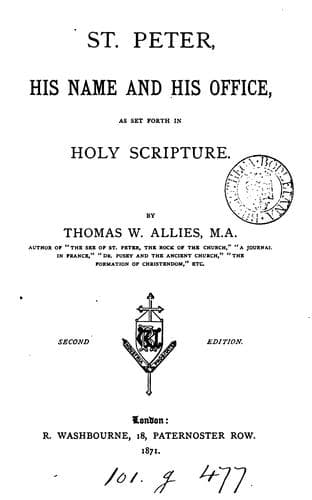
St. Peter, His Name and His Office, as Set Forth in Holy ScriptureAllies, T. W. (Thomas William)
Religion
St. Peter, His Name and His Office, as Set Forth in Holy Scripture
Allies, T. W. (Thomas William)
Peter, the Apostle, Saint
[21] Hegoumenos.
[22] John xiii. 13.
[23] Passaglia, p. 82.
[24] Matt. xxiii. 8.
[25] John chps. x., xiii., xvii.
[26] Dialog. cont. Lucif. n. 9.
[27] St. Cyprian, Ep. 46.
[28] Passaglia, p. 89.
[29] Exetesato. The word in classic Greek has this force.
[30] Serm. 4, c. 3.
[31] Rom. xvi. 25; 2 Cor. i. 21; 1 Pet v. 10.
[32] Col. ii. 6; 1 Cor. i. 7; 2 Thess. ii. 16.
[33] John xvi. 13; xiv. 16, 26; Eph. iii. 16.
[34] Passaglia, p. 563.
[35] 1 Pet. v. 10.
[36] Apoc. iii. 2.
[37] Rom. xvi. 25; 1 Thess. iii. 13; 2 Thess. ii. 17; 1 Pet. v. 10.
[38] Rom. i. 11.
[39] Apoc. iii. 2.
[40] S. Cyprian, Ep. 55.
[41] As far as the _words_ by themselves go, it is the opinion of
the best commentators that they may be equally well rendered, "And
thou, when thou art converted," or, "And thou, in thy turn, one
day," &c. But as it is impossible to bring a discussion turning on a
Hebrew idiom conveyed in a Greek word before the English reader, we
must here restrict ourselves to the proof arising from the _sense_
and _context_. And here one thing alone, among several which may be
urged, is sufficient to prove that the sense preferred in the text,
"And thou in thy turn one day confirm thy brethren," is the true
one. For the other rendering supposes that the time of Peter's
conversion would also be the time of his confirming his brethren;
whereas this was far otherwise. He was converted by our Lord looking
on him that same night shortly after his denial, and "immediately
went out and wept bitterly." But he did not succeed to the charge of
confirming his brethren till after our Lord's ascension. It must be
added that the collocation of the original words kai su pote
epistrepsas sterixon is such as absolutely to require that the
joint action indicated by them should belong to the same time, and
that an _indefinite_ time expressed by pote. Now this would
be false according to the rendering, "And thou, when thou art
converted, confirm thy brethren," for the conversion was immediate
and definite, the confirmation distant and indefinite; whereas it
exactly agrees with the rendering, "And thou in thy turn one day
confirm thy brethren."
Those who wish to see the whole controversy admirably drawn out may
find it in Passaglia, b. 2, ch. 13.
[42] Mansi. Concilia, x. 894.
[43] Baronius, Annal. A.D., 817, xxi.
[44] Passaglia, p. 545.
[45] Passaglia, p. 547.
[46] Passaglia, p. 571.
[47] For which see hereafter, ch. 7.
[48] Eph. iv. 11.
[49] Petrus uti audivit, vos autem quid me dicitis? _Statim loci non
immemor sui, primatum egit_; primatum confessionis utique, non
honoris; primatum fidei, non ordinis. Ambros. de Incarn. c. 4, n.
32, Tom. 2, p. 710.
[50] Ep. 190, vol. 1, p. 649.
[51] Observe the exact identity with S. Cyprian's expression nine
hundred years earlier, quoted p. 55.
[52] Twenty-fifth letter among those of St. Leo.
[53] Con. Symmachum, Lib. 2, v. 1.
[54] Sermon 76.
[55] Hom. 88, on John.
[56] Encom. in Petrum et coeteros Apostolos.
Public-domain text, read in full here on John Shaqi.
Reviews
Reviews
No reviews yet
Be the first to share your thoughts on this work.
Join the Discussion
Join the discussion
Sign in to leave a comment or review.
Sign InorCreate an account