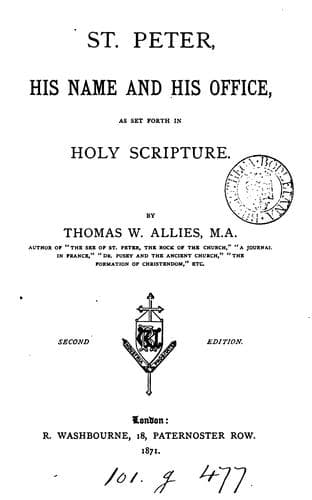
St. Peter, His Name and His Office, as Set Forth in Holy ScriptureAllies, T. W. (Thomas William)
Religion
St. Peter, His Name and His Office, as Set Forth in Holy Scripture
Allies, T. W. (Thomas William)
Peter, the Apostle, Saint
But now we come to those most important injunctions which our Lord
gave to His Apostles after His resurrection, concerning the
government of His Church. And here it becomes necessary to mark with
the utmost accuracy what He said and what He gave to all the
Apostles in common, and what to Peter in particular.
First of all, then, we may remark our Lord's care to redeem the
promises which He had made to the Twelve, and to convey to them
their legislative, judicial, and executive powers. These are
mentioned by each of the four Evangelists, in somewhat different
terms, but alike involving the distinctive apostolic powers of
immediate institution by Christ, and universal mission; as Apostles
they are _sent_, and they are sent _by Christ_. The form recorded in
S. Matthew is, "All power is given unto Me in heaven and in earth.
Go ye, therefore, and make disciples all nations, baptizing them in
the name of the Father, and of the Son, and of the Holy Ghost,
teaching them to observe all things whatsoever I have commanded you;
and behold I am with you all days, even to the consummation of the
world."
The form of S. Mark is, "Go ye into the whole world, and preach the
gospel to every creature."
S. Luke refers specially in two passages to the descent of the Holy
Ghost, as being Himself as well the Divine "Gift," and the immediate
worker of all graces in man, as the principle of the ecclesiastical
hierarchy. "And I send the promise of My Father upon you, but stay
you in the city till you be endued with power from on high." And
again, "Eating together with them, He commanded them that they
should not depart from Jerusalem, but should wait for the promise of
the Father, which you have heard," saith He, "by My mouth; for John,
indeed, baptized with water, but you shall be baptized with the Holy
Ghost not many days hence." "You shall receive the power of the Holy
Ghost coming upon you, and you shall be witnesses unto Me in
Jerusalem, and in all Judea, and Samaria, and even to the uttermost
part of the earth."
The form recorded by S. John is, "As the Father hath sent Me, I also
send you. When He had said this, He breathed on them; and He said to
them, Receive ye the Holy Ghost; whose sins you shall forgive, they
are forgiven them; and whose sins you shall retain, they are
retained."[7]
Now, it may be remarked that these passages of the several
evangelists are _identical_ in their force; that is, they each
convey all those powers which constitute the Apostolate. These are
received by all the Apostles in common, and together; and in the
joint possession of them consists that _equality_ which is often
attributed by the ancient writers to the Apostles, as notably by S.
Cyprian, "He gives to all the Apostles an equal power, and says, 'as
the Father sent Me, I also send you.'" And again, "Certainly the
other Apostles also were what Peter was, endued with an equal
fellowship, both of honour and power."[8]
Public-domain text, read in full here on John Shaqi.
Reviews
Reviews
No reviews yet
Be the first to share your thoughts on this work.
Join the Discussion
Join the discussion
Sign in to leave a comment or review.
Sign InorCreate an account