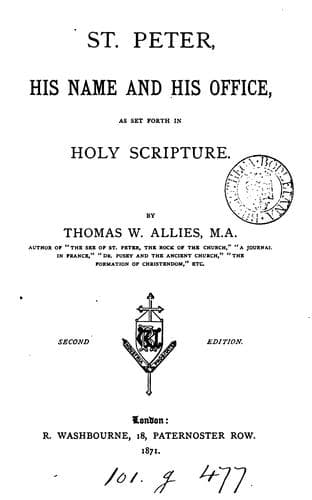
St. Peter, His Name and His Office, as Set Forth in Holy ScriptureAllies, T. W. (Thomas William)
Religion
St. Peter, His Name and His Office, as Set Forth in Holy Scripture
Allies, T. W. (Thomas William)
Peter, the Apostle, Saint
And that the universal and supreme authority over the Church of
Christ, was in these words committed to Peter by the Lord, is the
belief of antiquity. Thus, S. Ambrose, in the west: "It is not
doubtful that Peter believed, and believed because he loved, and
loved because he believed. Whence, too, he is grieved at being asked
a third time, Lovest thou Me? For we ask those of whom we doubt. But
the Lord does not doubt, but asks not to learn, but to teach him
whom, on the point of ascending into heaven, He was leaving, _as it
were, the successor and representative of His love_.[21] It is
because he alone out of all makes a profession, that _he is
preferred to all_. Lastly, for the third time, the Lord asks him, no
longer, _hast_ thou _a regard_ (diligis me) for Me, but _lovest_
(amas) thou Me: and now he is ordered to feed, not the lambs, as at
first, who need a milk diet, nor the little sheep, as secondly, but
the more perfect sheep, _in order that he who was the more perfect
might have the government_."[22] In the East, S. Chrysostome, "Why,
then, passing by the rest, does He converse with him on these
things? _He was the chosen of the Apostles, and the mouthpiece of
the disciples, and the head of the band._ Therefore, also Paul once
went up to see him rather than the rest. It was, besides, to shew
him, that for the future he must be bold, as his denial was done
away with, that _He puts into his hands the presidency over the
brethren._ And He does not mention the denial, nor reproach him with
what had past; but He says, if thou lovest Me, _rule the brethren_,
and show now that warm affection which on all occasions thou didst
exhibit, and in which thou didst exult, and the life which thou
didst offer to lay down for Me, now spend for My sheep." Again,
"thrice He asks the question, and thrice lays on him the same
command, showing at how high a price He sets _the charge of His own
sheep_." Again, "he was put in charge with the direction of his
brethren." "He made him great promises _and put the world into his
hands_." Thus John and James, and the rest of the Apostles were
committed to Peter, but never Peter to them: and he adds, "But if
any one asks, How then did James receive the throne of Jerusalem? I
would reply that He elected Peter _not to be the teacher of this
throne, but of the whole world_." And in another place, "Why did He
shed His blood to purchase those sheep _which He committed to Peter
and his successors_? With reason then said Christ, 'who is the
faithful and prudent servant whom his Lord hath set over His own[23]
house?'" Theophylact repeated, seven hundred years later, the
perpetual tradition of the East. "He puts into Peter's hands the
headship over the sheep of the whole world, and to no other but to
him gives He this; first, because he was distinguished above all,
and the mouth-piece of the whole band; and secondly, showing to him
that he must be confident, as his denial was put out of account."
And if S.
Public-domain text, read in full here on John Shaqi.
Reviews
Reviews
No reviews yet
Be the first to share your thoughts on this work.
Elsewhere in the archive
Join the Discussion
Join the discussion
Sign in to leave a comment or review.
Sign InorCreate an account