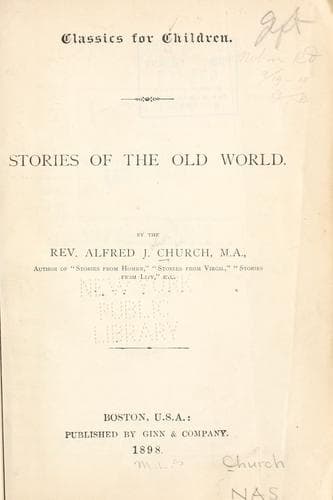
Mythology, Greek -- Juvenile literature; Mythology, Roman -- Juvenile literature
And Paris answered, “Brother, thou hast spoken well. It was not in
wrath that I sat here. I was vexed at my sore defeat. But now my wife
has urged me to join the battle, and truly it is well, for victory
comes now to one and now to another. Wait thou, then, till I don my
arms, or if thou wouldst depart, I will overtake thee.”
So Hector departed and went to his own home, seeking his wife
Andromaché, but found her not, for she was on a tower of the wall with
her child and her child’s nurse, weeping sore for fear. And Hector
spake to the maids,--
“Tell me, whither went the white-armed Andromaché; to see some
sister-in-law, or to the temple of Athené with the mothers of Troy?”
“Nay,” said an aged woman, keeper of the house. “She went to one of
the towers of the wall, for she had heard that the Greeks were pressing
our people hard. She hasted like as she were mad, and the nurse carried
the child.”
So Hector ran through the city to the Scæan gates, and there Andromaché
spied him, and hasted to meet him--Andromaché, daughter of King Eëtion,
of Thebé-under-Placus. And with her was the nurse, bearing the young
child on her bosom--Hector’s only child, beautiful, headed as a star.
His father called him Scamandrius, after the river, but the sons of
Troy called him Astyanax, the “City-King,” because it was his father
who saved the city. Silently he smiled when he saw the child, but
Andromaché clasped his hand and wept, and said,--
“O Hector, thy courage will bring thee to death. Thou hast no pity on
thy wife and child, but sparest not thyself, and all the Greeks will
rush on thee and slay thee. It were better for me, losing thee, to die;
for I have no comfort but thee. My father is dead, for Achilles slew
him in Thebé--slew him but spoiled him not, so much he reverenced him.
With his arms he burnt him, and the mountain-nymphs planted poplars
about his grave. Seven brethren I had, and lo! they all fell in one day
by the hand of the great Achilles. And my mother, she is dead, for when
she had been ransomed, Artemis smote her with an arrow in her father’s
house. But thou art father to me, and mother and brother and husband
also. Have pity, then, and stay here upon the wall, lest thou leave me
a widow and thy child an orphan. And set the people here in array by
this fig-tree, where the city is easiest to be taken; for there come
the bravest of the Greeks, Ajax the Greater, and Ajax the Less, and
Idomeneus, and the two sons of Atreus, and the son of Tydeus.”
Public-domain text, read in full here on John Shaqi.
Reviews
Reviews
No reviews yet
Be the first to share your thoughts on this work.
Elsewhere in the archive
Join the Discussion
Join the discussion
Sign in to leave a comment or review.
Sign InorCreate an account