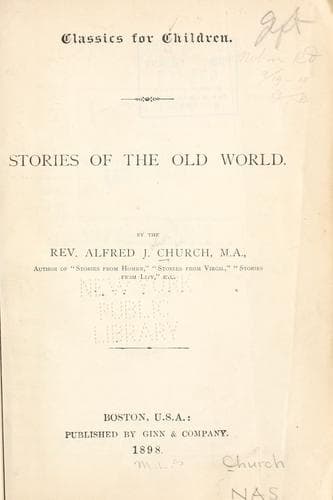
Mythology, Greek -- Juvenile literature; Mythology, Roman -- Juvenile literature
The next day the battle was set in array as before. And all the morning
the armies fought without advantage to the one or the other; but at
noon, at the hour when one who cuts wood upon the hills sits down
to his meal, the Greeks prevailed and drove back the sons of Troy.
Nor was there one of all the chiefs who fought so bravely as King
Agamemnon. Many valiant men he slew, and among them the two sons of
Antimachus. These, indeed, he took alive in their chariot, for they
had dropped the reins, and stood helpless before him, crying out that
he should spare them and take ransom, for that Antimachus their father
had much gold and bronze and iron in his house, and would gladly buy
them back alive. Now Antimachus had taken a bribe from Prince Paris,
and had given counsel to the Trojans that they should not give back
the fair Helen. So when King Agamemnon heard them, he said, “Nay, but
if ye be sons of Antimachus, who counselled the men of Troy that they
should slay Menelaüs when he came an ambassador to their city, ye
shall die for your father’s sin.” So he slew them both, and leaving
them he still rushed on, driving back the Trojans even to the walls
of their city. Nor did Hector himself dare to meet him, for Zeus had
sent him a message saying that he should hold himself back till King
Agamemnon should chance to be wounded. And indeed this chance happened
presently, for the king had slain Iphidamas, son to Antenor, and Coön,
his brother, the eldest born, was very wroth to see it. So standing
sideways he aimed with his spear, Agamemnon not knowing, and smote
the king in the hand near the wrist. Then he seized the body of his
brother, and shouted to his comrades that they should help him; but
Agamemnon dealt him a deadly blow underneath his shield. So he fell;
and for a while, while the wound was warm, the king fought as before;
but when it grew cold and stiff great pain came upon him, and he leapt
into his chariot and bade the charioteer drive him to the ships, for
that he could fight no more.
Then again the battle went for the Trojans, though Diomed and Ulysses,
who fought very valiantly, stayed it awhile, Diomed coming very near to
slay Hector. But Paris, who was in hiding behind the pillar on the tomb
of Ilus, drew his bow, and smote him with an arrow through the ankle of
the right foot. Loud he boasted of his aim. “Only,” he said, “I would
that I had pierced thee in the loin; then hadst thou troubled the sons
of Troy no more.”
But Diomed answered, “Small good were thy bow to thee, cowardly archer,
if thou shouldst dare to meet me face to face. And as for this graze on
my foot, I care no more than if a woman or child had smitten me. Not
such the wounds I deal; as for those that meet my spear in the battle,
I trow that they are dearer to the fowls of the air than to women in
the chamber.”
Public-domain text, read in full here on John Shaqi.
Reviews
Reviews
No reviews yet
Be the first to share your thoughts on this work.
Elsewhere in the archive
Join the Discussion
Join the discussion
Sign in to leave a comment or review.
Sign InorCreate an account