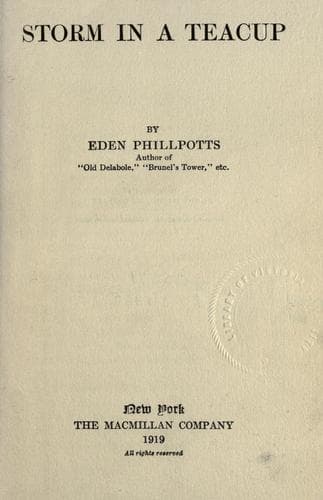
Devon (England) -- Fiction; Husband and wife -- Fiction; Man-woman relationships -- Fiction; Paper mills -- Fiction
So the process was endlessly repeated, and when the coucher’s pile
of paper, with woollen welts between each new sheet, had grown large
enough, it was removed, drawn away on a little trolley, which ran upon
rails down the centre of the vat house, and taken to a press. Here the
mass under a steady strain showed that the new sheets were still half
water, for a fountain poured and spurted away on every side as the
lever was turned.
From this initial pressing each pile came back to the place of its
creation and the layer, the third worker in the trinity at each vat,
separated the paper from the woollens between the sheets and handed the
felts back to the coucher as he needed them for his own task. The three
men worked together like a machine with rhythmic action and wonderful
swiftness. Then came the interval; the din of the machinery ceased for
a while and the vatmen washed their hands.
Each manual craft leaves its own marks, by which one skilled may tell
a worker’s business, and the paper maker’s hands are deeply corned and
calloused along the palms and joints. They are his stock in trade and
he takes the utmost care of them, for a bleeding corn, or cut, or any
wound instantly disables him and he cannot tend the vat until they are
sound again.
At this moment Robert Life was out of action, with a sore on his
thumb, and employed for the time at other labour; but he joined the
men in the dinner hour and shared a discussion concerning the supreme
disaster which may fall to the vatman’s lot.
“Did you ever lose your stroke?” asked Life of Mr. Knox. “I’ve heard of
men that did—and never got it back no more.”
“May it never happen to you, Robert,” answered the elder, “for anything
more dreadful and shattering you can’t imagine. Yes, I lost my stroke
eight years ago; and I can remember every item of the tragedy as if it
was yesterday.”
“Along of illness?” asked Life, “or your own fault?”
“As I’m among friends,” replied Philander, “I’ll confess that it was
my own fault. I tell you these things as a warning to you younger men.
It was whiskey. I’d go on the burst sometimes, though never what you’d
call a drinker. But I held an opinion it was better to have a fair
wallow in it now and again with teetotal intervals, than to be always
drinking, you see; and once I overdid it and lost my stroke. I came
to the vat and dipped, but the touch was gone. I tried and failed and
washed off again and again; but I couldn’t make paper. They came round
me and said hopeful things, and I stood like a stuck pig among ’em and
the sweat poured down my face. Then I dropped the mould and sneaked
away and felt as if the end of the world had come. For I knew bitter
well that often and often the stroke once lost is never got back.”
“You got yours back, however?”
Public-domain text, read in full here on John Shaqi.
Reviews
Reviews
No reviews yet
Be the first to share your thoughts on this work.
Join the Discussion
Join the discussion
Sign in to leave a comment or review.
Sign InorCreate an account