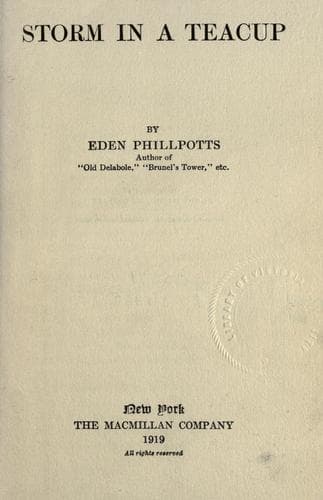
Devon (England) -- Fiction; Husband and wife -- Fiction; Man-woman relationships -- Fiction; Paper mills -- Fiction
“In my terror I signed the pledge and promised the Almighty a lot of
very fine things if He’d be merciful and let me regain my skill. My
self-respect was gone and I’d have grovelled to God, or anybody who
could help me. My foreman was a very good chap and understood the
nature of the disaster. He cheered me and felt so positive sure I
should get it back, that I began to think I should myself. For in such
case half the battle is to have cheerful, hopeful people about you,
who’ll make light of the tragedy and say it’s going to be all right.
The moral effect of that helps you to hope against hope and recover
your nerve, when you come to try again. It’s all nerve really, and if
you can get back your nerve, then you’ll probably get back your stroke.”
“At the third trial I got mine back anyway, and ’twas a very fine
example of the best in human nature to see how my coucher and layer
shook hands with me when I made my first sheet and how glad my fellow
vatmen were about it.”
“And did you keep all your good promises?” asked Kellock.
“For practical purposes, yes,” answered Philander. “I improved a good
bit after that adventure and never went on the burst again. The pledge,
however, I did not keep, because by experiment I found I could work
better on beer than water; but spirits are a thing of the past. I don’t
drink more than a whiskey or two a week now-a-days.”
Kellock, at one stage in his secret thoughts at this season, had found
his heart faint somewhat, for by temperament thus far he had been
a thinker rather than a doer. His work ended, his leisure had been
largely devoted to the welfare of his class, and he doubted not that he
would turn a great part of his energies to labour questions and even
abandon paper-making for a political career some day. Such was his
dream; but for the present that had been swept aside.
Thoughts of his own future gave him no lasting uneasiness. Whether
he stopped at Dene, or went elsewhere, after running away with Mrs.
Dingle, mattered nothing to him. His skill commanded a ready market
and he could get work for the asking. He guessed, indeed, that Medora
must desire to live as far from the haunts of her tragedy as possible;
but he also knew that Matthew Trenchard would wish to keep him if
he could. A more pressing problem concerned the future of Medora’s
husband. Kellock’s orderly mind above all things would have liked to go
to Ned, state the case clearly, prove to him that he was never destined
to make his wife a happy woman and frankly suggest a change of partners
for Medora. He was actually tempted to do this, and even went so far as
to suggest it to Mrs. Dingle; but she, hiding a secret amazement at any
enterprise so unromantic, assured him that such an action could only
serve greatly to complicate their future if it did not actually ruin
their plans altogether.
Public-domain text, read in full here on John Shaqi.
Reviews
Reviews
No reviews yet
Be the first to share your thoughts on this work.
Join the Discussion
Join the discussion
Sign in to leave a comment or review.
Sign InorCreate an account