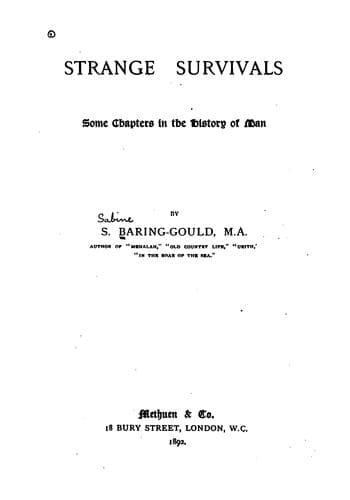
Strange Survivals: Some Chapters in the History of ManBaring-Gould, S. (Sabine)
History
Strange Survivals: Some Chapters in the History of Man
Baring-Gould, S. (Sabine)
Manners and customs -- Origin; Superstition
Then she gave him some of the seaweed. He chewed it, and naturally both
became very thirsty.
Presently Thorgerthr said she must taste a drop of water. She rose,
went to the door, and called for water. Her mother brought a drinking
horn. Thorgerthr took a slender draught, and offered the horn to her
father.
“Certainly,” said he, “that weed has parched my throat with thirst.” So
he lifted the horn with both hands, and drained it.
“Father,” said Thorgerthr, “we have both been deceived; we have been
drinking milk.” As she spoke, the old man clenched his teeth in the
horn, and tore a great shred from it, then flung the vessel wrathfully
on the ground.
“Our scheme has failed,” said Thorgerthr, “and we cannot now continue
it. I have a better plan to propose. Compose a death-lay on your son,
Bödvar, and I will carve it in runes on oaken staves.”
Then the spirit of song came on the old man, and he composed the long
Wake-song of Bödvar that goes by the name of the Sonartorrek, and in
singing it his grief was assuaged.
The invasion of the Northmen, of Dane and Viking of Norway, that
made the Saxons tremble, was an invasion of something more than
marauders--it was one of four-post beds. They did not, indeed, bring
their press beds with them in their “Long Serpents,” but no sooner
did they establish themselves in the land--Ragnar Lodbrog’s sons
in Northumbria, and King Knut in England--than they set up their
four-posters, and made themselves both secure and comfortable. They
shut themselves in for the night, pulled the bolt, and were safe till
next morning. We do not half understand the horrors of St. Brice’s
Day, 1002, when the Danes were massacred throughout the dominions of
Æthelred, unless we introduce these closed beds into the picture. We
must imagine the Saxons storming the closed and bolted boxes, and
the Danes within, unable to escape, as the axes and crowbars crashed
against the oak doors and hinges of their _lokhvilur_. They could but
muffle themselves in their feather beds, and endeavour to burst forth
when the entrance was forced.
The cairn, or tumulus, that covered a dead Norseman was heaped over a
sort of wooden or stone bed made after the fashion of a _lokhvila_. In
the Grettis saga we have the story of the hero breaking into the cairn
of an old king, and he found him enclosed in a box of boards--stout
oak planks--very much as he had been shut in every night when he
retired to sleep. The _kistvaens_ of stone, oblong boxes of stones set
on end, and covered over with great slabs, to contain the dead, are
nothing other than stone four-posters. And the modern coffin is nought
else but the wooden enclosed _lokhvila_--the Scandinavian close bed
reduced to the smallest possible dimensions. There is no particular
sense in the coffin, but it is a reminiscence of what the beds of our
Scandinavian forefathers were, and will continue to be used long after
the four-poster is banished from our bedrooms.
Public-domain text, read in full here on John Shaqi.
Reviews
Reviews
No reviews yet
Be the first to share your thoughts on this work.
Elsewhere in the archive
Join the Discussion
Join the discussion
Sign in to leave a comment or review.
Sign InorCreate an account