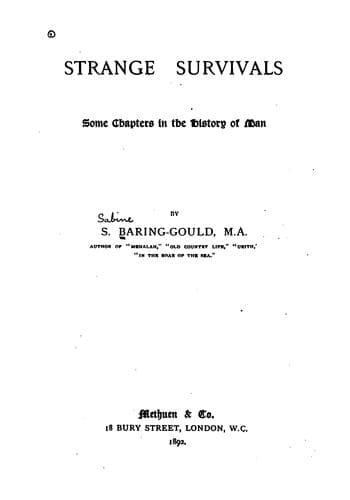
Strange Survivals: Some Chapters in the History of ManBaring-Gould, S. (Sabine)
History
Strange Survivals: Some Chapters in the History of Man
Baring-Gould, S. (Sabine)
Manners and customs -- Origin; Superstition
In the saga of Egil and Asmund is a queer story of two men who swore
brotherhood with each other, that he who survived the other should
spend three nights in the cairn with his dead brother, “and then depart
_if he liked_.” The saga goes on to tell how that one of these, Aran,
was slain, then his fellow, Asmund, “threw up a cairn, and placed by
the dead man his horse, with saddle and bridle, and all his harness
and his banner, his hawk, also, and his hound; Aran sat in the high
stool in full armour. Then Asmund had his chair brought into the cairn
and sat there, and the cairn was closed on them. In the first night
Aran rose from his stool and killed hawk and hound, and ate them both.
In the second night Aran stood up and slew his horse, and tore it in
pieces, rending it with his teeth, and he ate the horse, the blood
running over his jaws. And he invited Asmund to eat with him. The third
night Asmund felt heavy with sleep, and he snoozed off, and was not
aware before the dead man had gripped him by both ears and had torn
them off his head. Asmund then drew his sword, hewed off the head of
Aran, took fire, and burned him to ashes. Then he went to the rope and
was drawn up, and the cairn was closed. But Asmund carried away with
him all the treasure it contained.”[20]
The Norsemen were buried seated in their chairs or in their boats, but
the builders of the megalithic monuments were interred lying on their
sides, with their hands folded, as though in sleep. Their great dolmens
and covered avenues were family cemeteries. The slab at the east end
was movable, so as to allow of admission into the tomb on each fresh
death in the family. A hole in the stone at the foot is very usual. Of
that elsewhere. The latest interments in a dolmen are always nearest
the opening; sometimes the more ancient dead have been removed farther
back in the monument to make room for the new-comers. There is an
allusion in Snorn’s Heimskringla to these holes in the kists containing
the dead: “Freyr fell sick and his men raised a great mound, in which
they placed a door with three holes in it. Now when Freyr was dead they
conveyed him secretly into the mound, but told the Swedes he was alive;
and they kept watch over him for three years. They brought all the
taxes into the mound--through one hole they thrust in the gold, through
another they put in the silver, and through the third the copper money
that was paid.”[21]
It is probable that the Scandinavians followed to some extent the usage
of the race that preceded them, and used their megalithic monuments,
much as we know that tumuli were employed for later interments, and by
races different from that which raised the tumuli. That the idea of
sleep was connected with death in many cases of burials, is certain,
from the position given to the corpse, the hands are folded and the
knees drawn up.
Public-domain text, read in full here on John Shaqi.
Reviews
Reviews
No reviews yet
Be the first to share your thoughts on this work.
Elsewhere in the archive
Join the Discussion
Join the discussion
Sign in to leave a comment or review.
Sign InorCreate an account