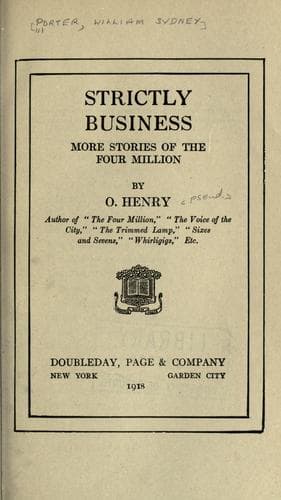
Strictly Business: More Stories of the Four MillionHenry, O.
Philosophy
Strictly Business: More Stories of the Four Million
Henry, O.
New York (N.Y.) -- Social life and customs -- Fiction
“There was a story about that chap a month or two ago,” said the
reporter. “They gave me the assignment. It was to run a column and was
to be on the extremely light and joking order. The old man seems to
like the funny touch I give to local happenings. Oh, yes, I’m working
on a farce comedy now. Well, I went down to the house and got all the
details; but I certainly fell down on that job. I went back and turned
in a comic write-up of an east side funeral instead. Why? Oh, I
couldn’t seem to get hold of it with my funny hooks, somehow. Maybe you
could make a one-act tragedy out of it for a curtain-raiser. I’ll give
you the details.”
After the performance my friend, the reporter, recited to me the facts
over the Würzburger.
“I see no reason,” said I, when he had concluded, “why that shouldn’t
make a rattling good funny story. Those three people couldn’t have
acted in a more absurd and preposterous manner if they had been real
actors in a real theatre. I’m really afraid that all the stage is a
world, anyhow, and all the players men and women. ‘The thing’s the
play,’ is the way I quote Mr. Shakespeare.”
“Try it,” said the reporter.
“I will,” said I; and I did, to show him how he could have made a
humorous column of it for his paper.
There stands a house near Abingdon Square. On the ground floor there
has been for twenty-five years a little store where toys and notions
and stationery are sold.
One night twenty years ago there was a wedding in the rooms above the
store. The Widow Mayo owned the house and store. Her daughter Helen was
married to Frank Barry. John Delaney was best man. Helen was eighteen,
and her picture had been printed in a morning paper next to the
headlines of a “Wholesale Female Murderess” story from Butte, Mont. But
after your eye and intelligence had rejected the connection, you seized
your magnifying glass and read beneath the portrait her description as
one of a series of Prominent Beauties and Belles of the lower west
side.
Frank Barry and John Delaney were “prominent” young beaux of the same
side, and bosom friends, whom you expected to turn upon each other
every time the curtain went up. One who pays his money for orchestra
seats and fiction expects this. That is the first funny idea that has
turned up in the story yet. Both had made a great race for Helen’s
hand. When Frank won, John shook his hand and congratulated
him—honestly, he did.
After the ceremony Helen ran upstairs to put on her hat. She was
getting married in a traveling dress. She and Frank were going to Old
Point Comfort for a week. Downstairs the usual horde of gibbering
cave-dwellers were waiting with their hands full of old Congress
gaiters and paper bags of hominy.
Public-domain text, read in full here on John Shaqi.
Reviews
Reviews
No reviews yet
Be the first to share your thoughts on this work.
Join the Discussion
Join the discussion
Sign in to leave a comment or review.
Sign InorCreate an account