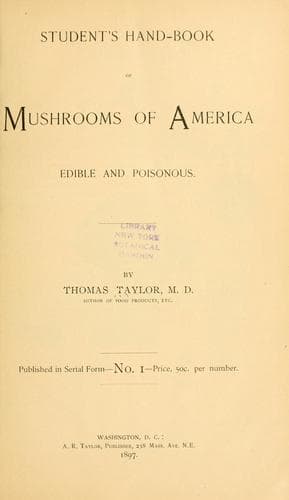
Student's Hand-book of Mushrooms of America, Edible and Poisonous — John Shaqi
Student's Hand-book of Mushrooms of America, Edible and PoisonousTaylor, Thomas
Science
Student's Hand-book of Mushrooms of America, Edible and Poisonous
Taylor, Thomas
Mushrooms -- United States; Pathogenic fungi
Place under a shed such amount of clean stable manure as may be required
for the beds, turning it over and over until all free ammonia has
escaped and the tendency of undue fermentation and evolution of high
temperature has greatly modified. To effect this, it is necessary to
heap up the manure each time in a mound, say three feet high after
turning, and beat it firmly down (the exclusion of free air prevents
overheating). To put the manure in proper condition for use in the beds,
from two to four weeks' treatment may be required, but much depends on
the quality of the manure and temperature of the atmosphere. Before
making the beds, and several days after the last turning, test the
internal temperature of the mound in the following manner: Make a hole
with a broomstick through the mound from top to bottom, and suspend a
thermometer half way down in the hole for, say, an hour. The temperature
may be as high as 150 F. After the lapse of the time stated, beat the
mound more firmly down to prevent rise of temperature. Test again two
days after in the same manner. If the temperature has risen several
degrees the mound must be again taken down, turned over, and remade. If,
on the other hand, the temperature has fallen to 100 F., the permanent
bed may be made. If indoor growth is desired, such as a cellar,
outbuilding, or cave, the atmosphere must not fall below 50 F., nor be
over 80 F. Air drafts cannot be permitted. The floor must be dry and
the atmosphere moist. The cellar may be dark, or moderately light.
Growers differ in opinion in this respect. Growers generally add to the
manure about one-fourth or one-fifth garden soil, but success has been
attained without the use of garden soil, except as surface dressing
after spawning the bed; an excessive use of loam, in any case, tends to
lower the temperature too rapidly. Having prepared a box or frame-work
for the bed twelve inches deep, fill it up to within two inches of the
top; beat gently down with a board, or a brick, until it is even and
compact. On the following day make holes in the bed, with a dibble, ten
inches deep, in which suspend a thermometer half way down for an hour.
Should the temperature have fallen to 90 F., cover lightly with straw
and test on the following day. Should the temperature prove to be going
down, say to 80 F., or 85 F., it is safe to plant the spawn; but
should the temperature be on the rise, wait until it is falling. One
grower has stated that his greatest success has been when the spawn was
planted at the temperature of 75 F. Should the temperature fall too
quickly and the surface be too dry, sprinkle with water at blood heat,
using a very fine hose, and cover the bed with straw.
Public-domain text, read in full here on John Shaqi.
Reviews
Reviews
No reviews yet
Be the first to share your thoughts on this work.
Join the Discussion
Join the discussion
Sign in to leave a comment or review.
Sign InorCreate an account