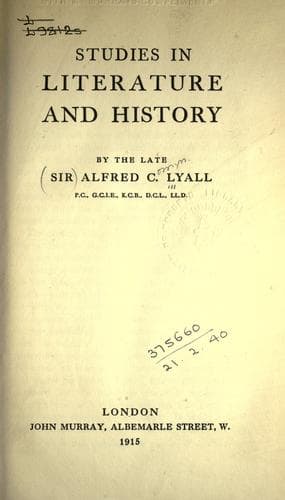
Studies in Literature and HistoryLyall, Alfred C., Sir
Religion
Studies in Literature and History
Lyall, Alfred C., Sir
English literature; History; Literature; Religion; Utilitarianism
loved colour and strong lineaments, and would always sacrifice minor
considerations to the production of a striking historical portrait.
Undoubtedly, Carlyle's letters have this virtue--that they largely
contribute to the creation of a true likeness of the writer, for in
sketching other people he was also drawing himself. He could also
paint the interior of a country house, as at Fryston, and his
landscapes are vivid. He was, in short, an impressionist of the first
order, who grouped all his details in subordination to a general
effect, and never gave his correspondent a mere catalogue of trivial
particulars.
It was originally in a letter to his brother that Carlyle wrote his
celebrated description of an interview with Coleridge. No two men
could be more different in taste or temperament, and yet any one who
reads attentively Coleridge's letters may observe a certain similarity
to Carlyle's writing, not only in the figured style and prophetic
manner, but also in the tendency of their political ideas. In the
matter of linguistic eccentricities, it may be guessed that both of
them had been affected by the study of German literature; and in
politics they had both a horror of disorder, an aversion to the
ordinary Radicalism of their day, and a contempt for mechanic
philosophy and complacent irreligion. Each of them had a strong belief
in the power and duties of the State; but Coleridge held also that
salvation lay in a reconstitution of the Church on a sound
metaphysical basis, whereas for Carlyle all articles and liturgies
were dying or dead. A comparison of these two supreme intellectual
forces may help us to distinguish some of the most favourable
conditions of good letter-writing. They were men of highly nervous
mental constitution of mind, on whom the ideas and impressions that
had been secreted produced an excitability that was discharged upon
correspondents in a torrent of language, sweeping away considerations
of reserve or self-regard, and submerging the commonplace bits of news
and everyday observations which accumulate in the letters of
respectable notabilities. To whomsoever the letters may be addressed,
they are in consequence equally good and characteristic. Carlyle's
epistles to his wife and brother are among the best in the collection;
and Coleridge threw himself with the same ardour into letters to
Charles Lamb and to Lord Liverpool. It is this capacity for pouring
out the soul in correspondence, for draining the bottom of one's heart
to a friend, which, combined with exaltation under the stimulus of
spleen or keen sensibility, raises correspondence to the high-water
mark of English literature.
Public-domain text, read in full here on John Shaqi.
Reviews
Reviews
No reviews yet
Be the first to share your thoughts on this work.
Join the Discussion
Join the discussion
Sign in to leave a comment or review.
Sign InorCreate an account