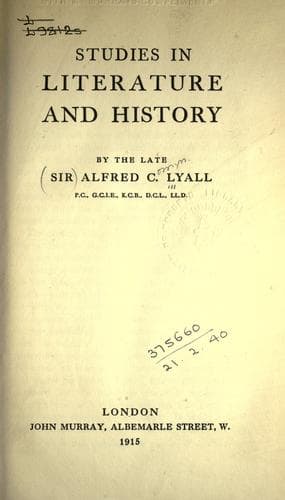
Studies in Literature and HistoryLyall, Alfred C., Sir
Religion
Studies in Literature and History
Lyall, Alfred C., Sir
English literature; History; Literature; Religion; Utilitarianism
Carlyle's letters, on the other hand, fall into the opposite category;
they stand on their own feet, they are as significant of style and
character as Arnold's, and even Stanley's, letters were comparatively
insignificant; they are the fearless outspoken expression of the
humours and feelings of the moment, and it is probable that the writer
did not trouble himself to consider whether they would or would not be
published. In these respects they as nearly fulfil the authorised
conditions of good letter-writing as any work of the sort that has
been produced in our own generation, though one may be permitted some
doubt in regard to improvisation; for the work is occasionally so
clean cut and pointed, his strokes are so keen and straight to the
mark, that it is difficult to believe the composition to be altogether
unstudied. Whether any writer ever excelled in this or, indeed, in any
other branch of the art literary without taking much trouble over it,
is, in our judgment, an open question; but surely Carlyle must have
selected and sharpened with some care the barbed epithets upon which
he suspends his grotesque and formidable caricatures.
For example, he writes, in 1831, of Godwin, who still figures, in
advanced age, as a martyr in the cause of good letter-writing--'A
bald, bushy browed, thick, hoary, hale little figure, with a very long
blunt characterless nose--the whole visit the most unutterable
stupidity.' Lord Althorp is 'a thick, large, broad-whiskered,
farmer-looking man.' O'Connell, 'a well-doing country shopkeeper with
a bottle-green frock and brown scratch wig.... I quitted them all (the
House of Commons) with the highest contempt.' Of Thomas Campbell, the
poet, it is written that 'his talk is small, contemptuous, and
shallow; his face has a smirk which would befit a shopman or an
auctioneer.' Wordsworth, 'an old, very loquacious, indeed, quite
prosing man.' Southey 'the shallowest chin, prominent snubbed Roman
nose, small carelined brow, the most vehement pair of faint hazel eyes
I have ever seen.' There is a savage caricature of Roebuck, and so
Carlyle goes on hanging up portraits of the notables whom he met and
conversed with, to the great edification of these latter days. No more
dangerous interviewer has ever practised professionally than this
artist in epithets, on whom the outward visible figure of a man
evidently made deep impressions; whereas the ordinary letter-writer is
usually content to record the small talk. As material for publication
his correspondence had three singular advantages. His earlier letters
were excellent, and we may hazard the generalisation that almost all
first-class letter-writing, like poetry, has been inspired by the
ardour and freshness and audacity of youth. He lived so long that
these letters could be published very soon after his death without
much damage to the susceptibilities of those whom his hard hitting
might concern; and, lastly, his biographer was a man of nerve, who
Public-domain text, read in full here on John Shaqi.
Reviews
Reviews
No reviews yet
Be the first to share your thoughts on this work.
Join the Discussion
Join the discussion
Sign in to leave a comment or review.
Sign InorCreate an account