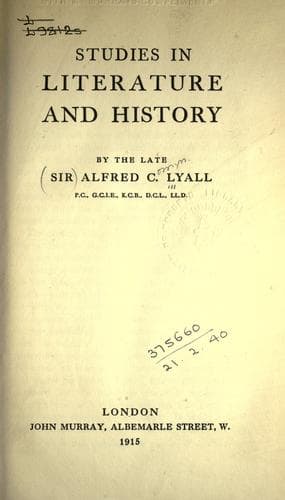
Studies in Literature and HistoryLyall, Alfred C., Sir
Religion
Studies in Literature and History
Lyall, Alfred C., Sir
English literature; History; Literature; Religion; Utilitarianism
'The sea,' he writes, 'somehow talks to one of old things,' probably
because it is changeless by comparison with the land; and a man whose
life is still and solitary is affected by the transitory aspect of
natural things, because he can watch them pass. As old friends drop
off he touches in his letters upon the memories of days that are gone,
and he consorts more and more with the personages of his favourite
poets and romancers, living thus, as he says, among shadows.
Here is a man to whom correspondence was a real solace and a vehicle
of thought and feeling, not a mere note-book of travel, nor a conduit
of confidential small talk. A faint odour of the seasons hangs round
some of these letters, of the sunshine and rain, of dark days and
roads blocked with snow, of the first spring crocus and the faded
autumnal garden plots. We can perceive that, as his retirement became
habitual with increasing age, the correspondence became his main
outlet of ideas and sensations, taking more and more the place of
friendly visits and personal discussion as a channel of intercourse
with the external world. The Hindu sages despised action as
destructive of thought; and undoubtedly the cool secluded vale of life
is good for the cultivation of letter-writing, in one who has the
artistic hand, and to whom this method of gathering up the fruits of
reading and meditation, the harvest of a quiet eye, comes easily. In
many respects the letters of FitzGerald, like his life, are in strong
contrast to Carlyle's; and FitzGerald was somewhat startled by the
publication of Carlyle's 'Reminiscences.' He thinks that, on the
whole, 'they had better have been kept unpublished;' though on reading
the 'Biography' he writes: 'I did not know that Carlyle was so good,
grand, and even lovable, till I read the letters which Froude now
edits.' He himself was not likely to give the general reader more than
he wished to be known about his private affairs; and if one or two
remarks with a sting in them appeared when these letters were first
published in a magazine, they have been carefully excerpted from the
book. The mellow music of his tones, the self-restraint and meditative
attitude, are pleasant to the reader after the turbid utterances and
twisted language of Carlyle; we may compare the stirring rebellious
spirit brooding over the folly of mankind with the man who takes
humanity as he finds it, and is content to make the best of a world in
which he sees not much, beyond art and nature and a few old friends,
to interest him. Upon the whole, we may place Carlyle and FitzGerald,
each in his very different manner, at the head of all the
letter-writers of the generation to which they belong, which is not
precisely our own. It is to be recollected that a man must be dead
before he can win reputation in this particular branch of literature,
and that he cannot be fairly judged until time has removed many
obstacles to unreserved publication. But both Carlyle and FitzGerald
had long lives.
Public-domain text, read in full here on John Shaqi.
Reviews
Reviews
No reviews yet
Be the first to share your thoughts on this work.
Elsewhere in the archive
Join the Discussion
Join the discussion
Sign in to leave a comment or review.
Sign InorCreate an account