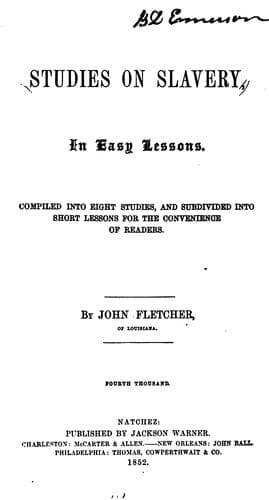
“It must be agreed that in most ages many countries have had part of
their inhabitants in a state of slavery; yet it may be doubted whether
slavery can ever be supposed the natural condition of man. It is
impossible not to conceive that men in their original state were equal;
and very difficult to imagine how one would be subjected to another but
by violent compulsion. An individual may, indeed, forfeit his liberty by
a crime; but he cannot by that crime forfeit the liberty of his
children. What is true of a criminal seems true likewise of a captive. A
man may accept life from a conquering enemy on condition of perpetual
servitude; but it is very doubtful whether he can entail that servitude
on his descendants; for no man can stipulate without commission for
another. The condition which he himself accepts, his son or grandson
would have rejected. If we should admit, what perhaps may with more
reason be denied, that there are certain relations between man and man
which may make slavery necessary and just, yet it can never be proved
that he who is now suing for his freedom ever stood in any of those
relations. He is certainly subject by no law, but that of violence, to
his present master, who pretends no claim to his obedience but that he
bought him from a merchant of slaves, whose right to sell him never was
examined. It is said that according to the constitutions of Jamaica he
was legally enslaved; these constitutions are merely positive, and
apparently injurious to the rights of mankind, because whoever is
exposed to sale is condemned to slavery without appeal, by whatever
fraud or violence he might have originally been brought into the
merchant’s power. In our own time, princes have been sold, by wretches
to whose care they were intrusted, that they might have an European
education; but when once they were brought to a market in the
plantations, little would avail either their dignity or their wrongs.
The laws of Jamaica afford a negro no redress. His colour is considered
as a sufficient testimony against him. It is to be lamented that moral
right should ever give way to political convenience. But if temptations
of interest are sometimes too strong for human virtue, let us at least
retain a virtue where there is no temptation to quit it. In the present
case there is apparent right on one side, and no convenience on the
other. Inhabitants of this island can neither gain riches nor power by
taking away the liberty of any part of the human species. The sum of the
argument is this: No man is by nature the property of another. The
defendant is, therefore, by nature, free. The rights of nature must be
some way forfeited before they can be justly taken away. That the
defendant has, by any act, forfeited the rights of nature, we require to
be proved; and if no proof of such forfeiture can be given, we doubt not
but the justice of the court will declare him free.”
Public-domain text, read in full here on John Shaqi.
Reviews
Reviews
No reviews yet
Be the first to share your thoughts on this work.
Join the Discussion
Join the discussion
Sign in to leave a comment or review.
Sign InorCreate an account