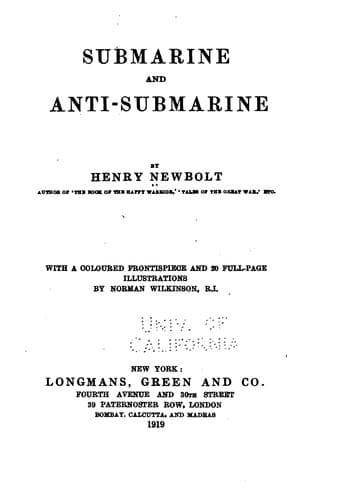
Submarine and Anti-submarineNewbolt, Henry John, Sir
History
Submarine and Anti-submarine
Newbolt, Henry John, Sir
Submarines (Ships); World War, 1914-1918 -- Naval operations -- Submarine
The story of the contest between our war-ships and their new enemy, the
submarine, is the story of a most remarkable and successful adaptation.
Of the six principal methods of defence used by our Navy at the end
of the fourth year of war, three are old and three new; and it is a
striking proof of the scientific ability of the Service, that the three
old methods have been carefully reconsidered, and that, instead of
abandoning them because, in their original use, they were apparently
obsolete, our officers have turned them to even better account than the
new inventions.
The oldest device for the protection of war-ships against
torpedoes--whether fired by torpedo-boats or submarines--is the net.
Our older battle-ships, as everyone will remember, were fitted with
a complete set of steel nets on both sides, and with long booms for
hanging them out. These booms, when not in use, were lashed diagonally
along the ship’s sides, like great stitches, and gave the typical
vessels of the British Fleet a peculiar and decidedly smart appearance.
Very smart, too, was the quickness and precision with which the order
‘Out torpedo nets!’ was executed; but--long before 1914--everyone was
perfectly aware that the nets were practically as much out of date as
masts and sails. They were so heavy, and hung so low in the water,
that no ship could manœuvre in them, and even for a fleet at anchor
they had ceased to be a trustworthy defence; for the Whitehead torpedo
was now fitted with cutters which could shear a way through the steel
meshes.
Nets of the old type, therefore, have played no part in the present
War--unless we are to believe the Turkish account of the sinking of the
_Ocean_ in the Dardanelles, according to which the nets were out, and
were not only useless as a protection, but dragged down some of our men
when they might otherwise have escaped by swimming. But, because one
type of net is obsolete, the British Navy has seen no reason to reject
all nets as impracticable. It is not beyond imagination to conceive a
net so light and large of mesh, that it will diminish by no more than
one knot the speed of the ship which carries it, and will yet catch
and deflect a torpedo in the act of passing through it. For it must be
remembered that the real problem is not how to stop a torpedo in its
full 30-knot career, but how to prevent it from striking the ship with
its head at an angle not too fine for the detonator to be fired. A turn
of the helm, or the mere wave from the cut-water of a fast ship, has
often sent a torpedo running harmlessly away along the quarter. The net
of the future may be found equally successful in catching the fish by
its whiskers and turning it forward along the bow, where the same wave
will drive it outwards from the ship’s course.
Public-domain text, read in full here on John Shaqi.
Reviews
Reviews
No reviews yet
Be the first to share your thoughts on this work.
Elsewhere in the archive
Join the Discussion
Join the discussion
Sign in to leave a comment or review.
Sign InorCreate an account