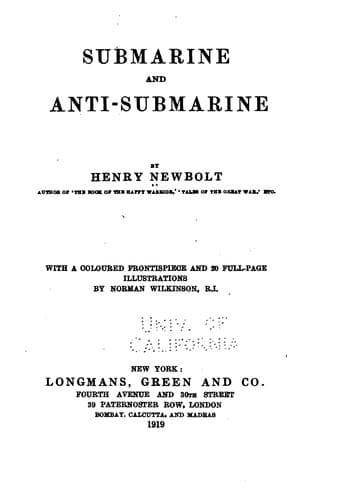
Submarine and Anti-submarineNewbolt, Henry John, Sir
History
Submarine and Anti-submarine
Newbolt, Henry John, Sir
Submarines (Ships); World War, 1914-1918 -- Naval operations -- Submarine
A third weapon of the war-ship was the ram; and the use of this,
being an offensive-defensive method, was the best of all, as we shall
see presently. It was, from the beginning, present to the mind of
every naval man, for A. 1 (our very first submarine) was lost, with
all hands, in May, 1904, by being accidentally rammed in the act of
submerging. It happened, too, that the first attack made by a submarine
against British war-ships in the present War was beaten by this
method. On August 9, 1914, a squadron of our light cruisers sighted
the periscope of a German U-boat, which had succeeded in approaching
to within short range of them. In the account of the affair published
at the time, we were informed that H.M.S. _Birmingham_ had sunk the
submarine by a direct hit on the periscope, and that this was the
only shot fired. Some time afterwards, the truth became known--the
_Birmingham_ had to her credit, not an impossible feat of gunnery, but
a brilliant piece of seamanship. She had gone full speed for the enemy,
and rammed him. Her captain was not led to do this by inspiration or
desperation, but by a scientific knowledge of the elements in the
problem. Without stopping to think afresh, he knew that a submarine
takes a certain time to dive to a safe depth, and that his own ship,
at 27 knots, would cover a good 900 yards of sea in one minute. When
his eye measured the distance of that periscope, he saw that--given
straight steering--the result was a mathematical certainty.
The new methods introduced during the War are also three in number.
Of one--the use of dazzle-painting--we have already heard. It is, of
course, a purely defensive measure, intended to deceive the eye at the
periscope by misrepresenting the ship’s size, distance, and course.
Another deceptive device is the phantom ship or dummy. A vessel of
comparatively small size and value is covered more or less completely
with a superstructure of light wood-work, with sham funnels, turrets
and big guns, so that she has all the appearance of a battle-cruiser or
Dreadnought. The U-boat may run after her, or run from her, according
to his feeling at the moment; but, in either case, he will be wasting
his time and laying up disappointment for himself. In May, 1915,
during the Gallipoli campaign, the Germans spent a certain amount of
time and trouble in torpedoing a ship which they supposed to be H.M.S.
_Agamemnon_, and in their illustrated propaganda sheets they give a
picture of that ship as one of the victims of the irresistible U-boats.
For a short time the story was believed inside Constantinople, and Mr.
Lewis Einstein, of the American Embassy there, relates in his diary
that this success, coming (as it appeared to do) immediately after
the sinking of the _Triumph_ and _Majestic_, was almost more than he
could bear. Fortunately for his peace of mind, he soon discovered the
truth. The supposed _Agamemnon_ was a dummy, and lay for some time
Public-domain text, read in full here on John Shaqi.
Reviews
Reviews
No reviews yet
Be the first to share your thoughts on this work.
Elsewhere in the archive
Join the Discussion
Join the discussion
Sign in to leave a comment or review.
Sign InorCreate an account