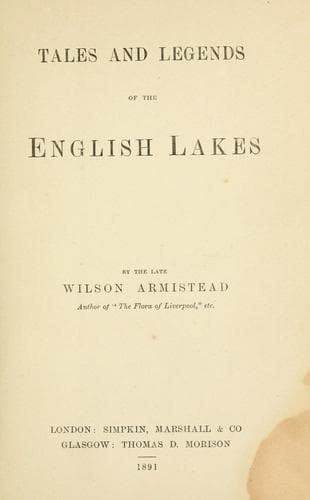
Tales and Legends of the English LakesArmistead, Wilson
General
Tales and Legends of the English Lakes
Armistead, Wilson
Folklore -- England -- Lake District; Legends -- England -- Lake District; Tales -- England -- Lake District
They ha'e had him up through Carlisle town,
And set him by the chimney fire;
They gave brave Noble a loaf to eat,
And that was little his desire,
They gave him a wheaten loaf to eat,
And after that a can of beer;
And they a' cried with one consent,
"Eat, brave Noble, and make gude cheir!
"Confess my lord's horse, Hobbie," they said,
"And to-morrow in Carlisle thou's na die."
"How can I confess them," Hobbie says,
"When I never saw them with my e'e?"
The Hobbie has sworn a fu' great aith,
By the day that he was gotten and born,
He never had onything o' my lord's,
That either eat him grass or corn.
"Now fare thee weel, sweet Mangerton!
For I think again I'll ne'er thee see:
I wad ha'e betrayed nae lad nor alive,
For a' the gowd o' Christentie.
"And fare thee weel, sweet Liddesdale!
Baith the hie land and the law;
Keep ye weel frae the traitor Mains!
For gowd and gear he'll sell ye a'.
"Yet wad I rather be ca'd Hobbie Noble,
In Carlisle where he suffers for his fau't,
Than I'd be ca'd the traitor Mains,
That eats and drinks o' the meal and maut."
Referring the reader to Percy's _Reliques_ for "Adam Bell, Clym of the
Clough, and William of Cloudesley," a long and interesting ballad of
this period, or somewhat earlier, we conclude this portion of the
poetical antiquities of Carlisle by a very beautiful and touching
ballad, "the lament of the border widow." It is founded upon the story
of Cockburn of Henderland, a noted disturber of the English districts;
who did not, however, suffer at Carlisle, though he had ravaged its
neighbourhood; nor at the hands of the English, whose laws he had
violated. James the Fifth, scandalized at the excesses of these border
reivers, made an excursion into their country in 1529, and executed
summary justice upon several of the most turbulent and lawless of them,
including the famous Johnnie Armstrong, Adam Scot of Tushielaw, and
Cockburn of Henderland.
The latter was hanged, by the King's order, over the gate of his own
keep, or tower, while his lady fled to the banks of a mountain-stream,
called the Henderland burn, and sat down at the foot of a foaming
cataract, to drown, amid the sound of the roaring waters, the noise of
the drums that announced the close of her husband's existence. The place
where she sat is still shown to the stranger. The author of the ballad
is unknown. It was taken down from recitation in the Ettrick forest, and
is as affecting a ballad as any in the language, abounding with touches
of genuine pathos, and most lovely simplicity of sorrow. Exquisite is
the whole composition; and many of the passages are worthy of the
greatest of poets.
My love, he built me a bonny bower,
And clad it a' wi' lilye flower,
A brawer bower ye ne'er did see,
Than my true love he built for me.
Public-domain text, read in full here on John Shaqi.
Reviews
Reviews
No reviews yet
Be the first to share your thoughts on this work.
Elsewhere in the archive
Join the Discussion
Join the discussion
Sign in to leave a comment or review.
Sign InorCreate an account