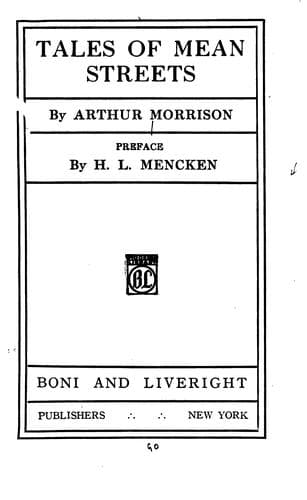
East End (London, England) -- Fiction; London (England) -- Social life and customs -- Fiction
The light spread fast and free, and in a few nights the Red Cow group
was a very promising little bed of Anarchy. Sotcher was at pains to have
it reported at two places west of Tottenham Court Road and at another in
Dean Street, Soho, that at last a comrade had secured an excellent
footing with a party of the proletariat of East London, hitherto looked
on as hopeless material. More: that an early manifestation of activity
might be expected in that quarter. Such activity had been held advisable
of late, in view of certain extraditions.
And Sotcher's discourse at the Red Cow turned, lightly and easily,
toward the question of explosives. Anybody could make them, he
explained; nothing simpler, with care. And here he posed at large in the
character of mysterious desperado, the wonder and admiration of all the
Red Cow group. They should buy nitric acid, he said, of the strongest
sort, and twice as much sulphuric acid. The shops where they sold
photographic materials were best and cheapest for these things, and no
questions were asked. They should mix the acids, and then add gently,
drop by drop, the best glycerine, taking care to keep everything cool.
After which the whole lot must be poured into water, to stand for an
hour. Then a thick, yellowish, oily stuff would be found to have sunk to
the bottom, which must be passed through several pails of water to be
cleansed: and there it was, a terrible explosive. You handled it with
care and poured it on brick-dust or dry sand, or anything of that sort
that would soak it up, and then it could be used with safety to the
operator.
The group listened with rapt attention, more than one pot stopping
half-way on its passage mouthwards. Then Jerry Shand wanted to know if
Sotcher had ever blown up anything or anybody himself.
The missionary admitted that that glory had not been his. "I'm one o'
the teachers, me frien's--one o' the pioneers that goes to show the way
for the active workers like you. I on'y come to explain the principles
an' set you in the right road to the social revolution, so as you may
get yer rights at last. It's for you to act."
Then he explained that action might be taken in two ways: either
individually or by mutual aid in the group. Individual work was much to
be preferred, being safer; but a particular undertaking often
necessitated co-operation. But that was for the workers to settle as the
occasion arose. However, one thing must be remembered. If the group
operated, each man must be watchful of the rest; there must be no half
measures, no timorousness; any comrade wavering, temporizing, or
behaving in any way suspiciously, must be straightway _suppressed_.
There must be no mistake about that. It was desperate and glorious work,
and there must be desperate and rapid methods both of striking and
guarding. These things he made clear in his best conspirator's manner:
with nods and scowls and a shaken forefinger, as of one accustomed to
oversetting empires.
Public-domain text, read in full here on John Shaqi.
Reviews
Reviews
No reviews yet
Be the first to share your thoughts on this work.
Elsewhere in the archive
Join the Discussion
Join the discussion
Sign in to leave a comment or review.
Sign InorCreate an account