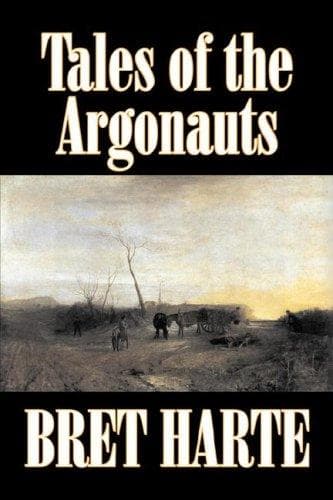
American fiction -- 19th century; Short stories; Western stories
He had changed pitifully in the last six months. His hair was a dusty,
yellowish gray, like the chemisal on the flanks of Heavytree Hill; his
face was waxen white, and blue and puffy under the eyes; his clothes
were soiled and shabby, streaked in front with the stains of
hurriedly eaten luncheons, and fluffy behind with the wool and hair of
hurriedly-extemporized couches. In obedience to that odd law, that, the
more seedy and soiled a man's garments become, the less does he seem
inclined to part with them, even during that portion of the twenty-four
hours when they are deemed less essential, Plunkett's clothes had
gradually taken on the appearance of a kind of a bark, or an outgrowth
from within, for which their possessor was not entirely responsible.
Howbeit, as he entered the room, he attempted to button his coat over
a dirty shirt, and passed his fingers, after the manner of some animal,
over his cracker-strewn beard, in recognition of a cleanly public
sentiment. But, even as he did so, the weak smile faded from his
lips; and his hand, after fumbling aimlessly around a button, dropped
helplessly at his side. For as he leaned his back against the bar, and
faced the group, he, for the first time, became aware that every eye but
one was fixed upon him. His quick, nervous apprehension at once leaped
to the truth. His miserable secret was out, and abroad in the very air
about him. As a last resort, he glanced despairingly at Henry York; but
his flushed face was turned toward the windows.
No word was spoken. As the bar-keeper silently swung a decanter and
glass before him, he took a cracker from a dish, and mumbled it with
affected unconcern. He lingered over his liquor until its potency
stiffened his relaxed sinews, and dulled the nervous edge of his
apprehension, and then he suddenly faced around. “It don't look as if we
were goin' to hev any rain much afore Christmas,” he said with defiant
ease.
No one made any reply.
“Just like this in '52, and again in '60. It's always been my opinion
that these dry seasons come reg'lar. I've said it afore. I say it again.
It's jist as I said about going home, you know,” he added with desperate
recklessness.
“Thar's a man,” said Abner Dean lazily, “ez sez you never went home.
Thar's a man ez sez you've been three years in Sonora. Thar's a man ez
sez you hain't seen your wife and daughter since '49. Thar's a man ez
sez you've been playin' this camp for six months.”
There was a dead silence. Then a voice said quite as quietly,--
“That man lies.”
It was not the old man's voice. Everybody turned as Henry York slowly
rose, stretching out his six feet of length, and, brushing away the
ashes that had fallen from his pipe upon his breast, deliberately placed
himself beside Plunkett, and faced the others.
Public-domain text, read in full here on John Shaqi.
Reviews
Reviews
No reviews yet
Be the first to share your thoughts on this work.
Join the Discussion
Join the discussion
Sign in to leave a comment or review.
Sign InorCreate an account