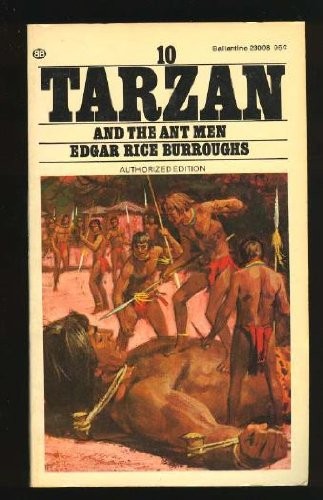
Adventure stories; Fantasy fiction; Tarzan (Fictitious character) -- Fiction
While the preparations for the expedition against Veltopismakus
were being carried on Tarzan was left much to his own devices. The
activities of these diminutive people were a never ending source of
interest to him. He watched the endless lines of slaves struggling with
their heavy burdens toward the new dome that was rising with almost
miraculous speed, or he strolled to the farmlands just beyond the city
where other slaves tilled the rich soil, which they scratched with
tiny plows drawn by teams of diadets, the diminutive antelope that
was their only beast of burden. Always were the slaves accompanied by
armed warriors if they were slaves of the first or second generation,
lest they should attempt escape or revolution, as well as a protection
against beasts of prey and human enemies, since the slaves were not
permitted to bear arms and, consequently, could not protect themselves.
These slaves of the first and second generations were always easily
recognizable by the vivid green tunic, reaching almost to the knees,
which was the single garment of their caste, and which carried upon
both its front and back an emblem or character in black that denoted
the city of the slave's birth and the individual to whom he now
belonged. The slaves employed upon public works all belonged to the
king, Adendrohahkis, but in the fields many families were represented
by their chattels.
Moving about the city upon their various duties were thousands of
white-tunicked slaves. They exercised the mounts of their masters,
they oversaw much of the more menial and laborious work of the lower
caste slaves, they plied their trades and sold their wares in perfect
freedom; but like the other slaves they wore but a single garment,
together with rough sandals which were common to both classes. On their
breasts and backs in red were the emblems of their masters. The second
generation slaves of the green tunics had a similar emblem, these
having been born in the city and being consequently considered a part
of it. There were other, though minor, distinguishing marks upon the
tunics of the higher caste slaves; small insignia upon one shoulder or
upon both, or upon a sleeve, denoting the occupation of the wearer.
Groom, body servant, major domo, cook, hair-dresser, worker in gold and
silver, potter--one could tell at a glance the vocation of each--and
each belonged, body and soul, to his master, who was compelled to
feed and clothe these dependents, the fruits of whose labors belonged
exclusively to him.
Public-domain text, read in full here on John Shaqi.
Reviews
Reviews
No reviews yet
Be the first to share your thoughts on this work.
Elsewhere in the archive
Join the Discussion
Join the discussion
Sign in to leave a comment or review.
Sign InorCreate an account