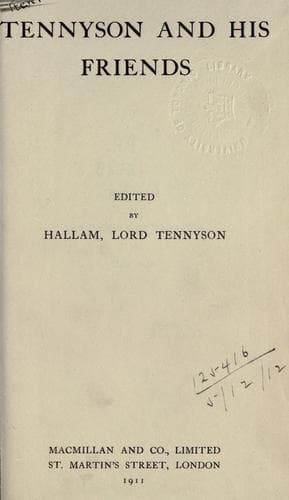
Tennyson, Alfred Tennyson, Baron, 1809-1892 -- Friends and associates
And so I send a birthday line
Of greeting; and my son, who dipt
In some forgotten book of mine
With sallow scraps of manuscript,
And dating many a year ago,
Has hit on this, which you will take
My Fitz, and welcome, as I know
Less for its own than for the sake
Of one recalling gracious times,
When, in our younger London days,
You found some merit in my rhymes,
And I more pleasure in your praise.
To E. FITZGERALD (_Tiresias and other Poems_, p. 1).
Alfred Tennyson and Edward FitzGerald; _In Memoriam_ and _The Rubáiyát of
Omar Khayyám_; "The Eternal Yea" and "The Eternal No," "the larger hope"
and "the desperate sort of thing unfortunately at the bottom of all
thinking men's minds, made Music of"--few friendships, few conjunctions,
personal or literary, could be more interesting or more piquant.
What adds to the interest of the friendship is that it remained so long
unknown to the literary or the general world, and is even now, perhaps,
only partially appreciated. Yet it subsisted for nearly fifty years. It
was close and constant. Though, as time went on, the two friends met less
and less often, it was maintained by a steady interchange of letters and
messages. The letters were naturally more on FitzGerald's side. Like most,
though not perhaps quite all good letter-writers, FitzGerald was a great
letter-writer. He was, as he often said, an idle man, and as he also said,
he rather liked writing letters, "unlike most Englishmen (but I am
Irish)," he added. Indeed, he seemed almost to prefer communication with
his friends by letter to personal meetings, though these he enjoyed
greatly when brought to the point.
Tennyson and FitzGerald were old friends, born in the same year, the
notable year 1809. It is true that though they were at Cambridge together
they were not then known to each other, except by sight. "I remember him
there well," said FitzGerald, speaking of Tennyson, "a sort of Hyperion."
They had many friendships, acquaintances, associations in common. Carlyle,
Thackeray, Spedding, Merivale, Trench, W. H. Thompson, J. D. Allen, W. B.
Donne, Brookfield, Cowell, Mrs. Kemble, Samuel Laurence, were known to
them both. In their formative years they fell under the same influences,
and read many of the same books. It was about 1835 that they became
acquainted. They were brought together probably by their common and
uncommon friend, James Spedding. They certainly met at his father's house,
Mirehouse, near Bassenthwaite Lake, in the spring of 1835.
Public-domain text, read in full here on John Shaqi.
Reviews
Reviews
No reviews yet
Be the first to share your thoughts on this work.
Join the Discussion
Join the discussion
Sign in to leave a comment or review.
Sign InorCreate an account