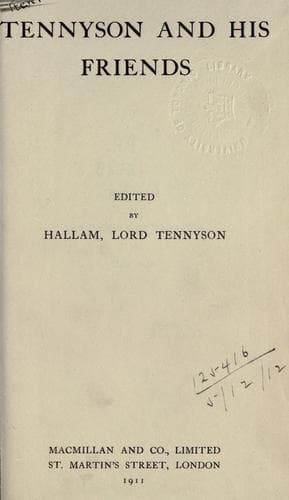
Tennyson, Alfred Tennyson, Baron, 1809-1892 -- Friends and associates
Quaritch, as FitzGerald expected, found no sale for _Omar_. He reduced the
price from five shillings to one shilling, and then to one penny. Rossetti
heard of it through Whitley Stokes, and showed it to Swinburne. They were
attracted by it and bought sixpenny-worth. Quaritch raised his price to
twopence. They carried off a few more, and the rest, a little later, were
eagerly bought up at a guinea or more apiece. Yet the poem remained long
known to very few. Quaritch published a second edition, again a small one,
nine years later in 1868, and four years later still, a third small
edition in 1872, and in 1879 a fourth edition, including Salámán and
Absál. The third edition came out just about the time I was going to
Oxford as an undergraduate, and it was then that I first heard of it
through J. A. Symonds and H. G. Dakyns, who gave me in 1874 a copy which
Symonds had presented to him, and which I still possess. Even at Oxford I
found only a few, either graduates or undergraduates, who heeded it or
knew anything about it. Professor Henry Smith was the only senior I can
remember who spoke to me about it, telling me of the previous editions,
and praising its merits one day as we turned it over together in Parker's
shop. But stealthily and underground it made its way. Edition followed
edition, with increasing rapidity. Suddenly it became ubiquitously
popular, and it is now certainly one of the best-known pieces of the kind
in the language. Messrs. Macmillan put it, in 1899, after a dozen times
reprinting it, into their Golden Treasury Series. They had to reprint
three times in that year, and this edition has been in constant demand.
But there are ever so many others. The poem has been reproduced in a
hundred forms, both in England and America, illustrated, illuminated,
decorated, annotated. A reprint of the first edition is once more sold for
a penny. It has been translated into Latin verse. There is a Concordance
to it. A whole literature has sprung up around it. An "Omar Khayyam Club"
was founded in 1892. Pious pilgrimages have been made to the translator's
tomb, and Omar's roses planted over it, and verses recited in celebration
of both poet and poem.
Of all this immense vogue and success, as his letters show, FitzGerald
himself never dreamed. Even when in 1885 Tennyson published, as the
dedication of _Tiresias and other Poems_, the lines "To E. FitzGerald,"
the translator of _Omar_ was still, for most readers, "a veiled prophet."
To-day, when the poem has become one of the utterances of the century,
lovers of paradox have even ventured to hint that instead of FitzGerald
being known as the friend of Tennyson, Tennyson might be known hereafter
as the friend of FitzGerald.
Public-domain text, read in full here on John Shaqi.
Reviews
Reviews
No reviews yet
Be the first to share your thoughts on this work.
Join the Discussion
Join the discussion
Sign in to leave a comment or review.
Sign InorCreate an account