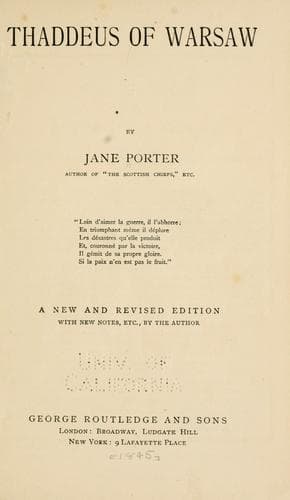
Poland -- History -- Stanislaus II Augustus, 1764-1795 -- Fiction
"Well, I grant it. I understood from you and Brinicki that you were
leading me against a set of violent, discontented men of rank, who,
in proportion as each was inflated with his own personal pride,
despised all of their own order who did not agree with them, and,
coalescing together under the name of freedom, were introducing
anarchy throughout a country which Catharine would graciously have
protected. All this I find to be in error. But both of you may have
been misled: the count by partiality and you by misrepresentation;
therefore I do not perceive why you should be in such a terror. The
wisest man in the world may see through bad lights; and why should
you think my father would never pardon you for having been so
unlucky?
"Yet to dispel your dread of such tidings ruining you with Sir
Robert, I will not be the first to tell him of our quixoting. Only
remember, my good sir,--though, to oblige you, I withhold my letters
to my mother, and when I arrive in England shall lock up my lips from
mentioning Poland,--that positively, I will not be mute one day
longer than that in which my father presents you with the living of
Somerset; then you will be independent of his displeasure, and I may,
and will, declare my everlasting gratitude to this illustrious
family.
"I am half mad when I think of leaving them. I must now tear myself
from this mansion of comfort and affection, to wander with you in
some rumbling old barouche 'over brake and through briar!' Well,
patience! Another such upset to your friends of the Neva, and with
'victory perched like an eagle on their laurelled brows,' I may have
some chance of wooing the Sobieskis to the banks of the Thames. At
present, I have not sufficient hope to keep me in good-humor.
"Meet me this day week at Dantzic: I shall there embark for England.
You had best not bring the foreign servants with you; they might
blab. Discharge them at St. Petersburg, and hire a courier for
yourself, whom we may drop at the seaport.
"I have the honor to remain,
"Dear sir,
"Your most obedient servant,
PEMBROKE SOMERSET.
"VILLANOW, _September_, 1792."
When Somerset joined his friends at supper, and imparted to them the
commands of his father, an immediate change was produced in the
spirits of the party. During the lamentations of the ladies and the
murmurs of the young men, the countess tried to dispel the effects of
the information by addressing Pembroke with a smile, and saying, "But
we hope that you have seen enough at Villanow to tempt you back again
at no very distant period? Tell Lady Somerset you have left a second
mother in Poland, who will long to receive another visit from her
adopted son."
"Yes, my dear madam," returned he; "and I shall hope, before a very
distant period, to see those two kind mothers united as intimately by
friendship as they are in my heart."
Public-domain text, read in full here on John Shaqi.
Reviews
Reviews
No reviews yet
Be the first to share your thoughts on this work.
Join the Discussion
Join the discussion
Sign in to leave a comment or review.
Sign InorCreate an account