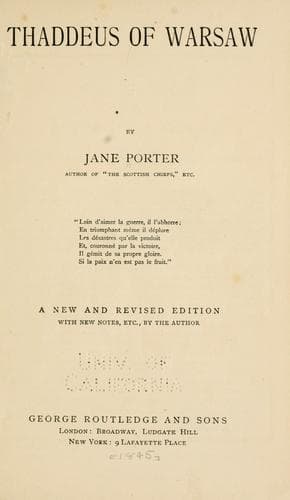
Poland -- History -- Stanislaus II Augustus, 1764-1795 -- Fiction
It being discovered that some Masovian regiments in the neighborhood
of Warsaw yet retained their arms, they were ordered by the foreign
envoys to lay them down. A few, thinking denial vain, obeyed; but
bolder spirits followed Thaddeus Sobieski towards South Prussia,
whither he had directed his steps on the arrest of his grandfather,
and where he had gathered and kept together a handful of brave men,
still faithful to their liberties. His name alone collected numbers
in every district through which he marched. Persecution from their
adversary as well as admiration of Thaddeus had given a resistless
power to his appearance, look, and voice, all of which had such an
effect on the peasantry, that they eagerly crowded to his standard,
whilst their young lords committed themselves without reserve to his
sole judgment and command. The Prussian ambassador, hearing of this,
sent to Stanislaus to command the grandson of Sobieski to disband his
troops. The king refusing, and his answer being communicated to the
Russian envoy also, war was renewed with redoubled fury.
The palatine remained in confinement, hopeless of obtaining release
without the aid of stratagem. His country's enemies were too well
aware of their interest to give freedom to so active an opponent.
They sought to vex his spirit with every mental torture; but he
rather received consolation than despair in the reports daily brought
to him by his jailers. They told him "that his grandson continued to
carry himself with such insolent opposition in the south, it would be
well if the empress, at the termination of the war, allowed him to
escape with banishment to Siberia." But every reproach thus levelled
at the palatine he found had been bought by some new success of
Thaddeus; and instead of permitting their malignity to intimidate his
age or alarm his affection, he told the officer (who kept guard in
his chambers) that if his grandson were to lose his head for fidelity
to Poland, he should behold him with as proud an eye mounting the
scaffold as entering the streets of Warsaw with her freedom in his
hand. "The only difference would be," continued Sobieski, "that as
the first cannot happen until all virtue be dead in this land, I
should regard his last gasp as the expiring sigh of that virtue
which, by him, had found a triumph even under the axe. But for the
second, it would be joy unutterable to behold the victory of justice
over rapine and violence! But, either way, Thaddeus Sobieski is still
the same--ready to die or ready to live for his country, and equally
worthy of the sacred halo with which posterity would encircle his
name forever."
Public-domain text, read in full here on John Shaqi.
Reviews
Reviews
No reviews yet
Be the first to share your thoughts on this work.
Elsewhere in the archive
Join the Discussion
Join the discussion
Sign in to leave a comment or review.
Sign InorCreate an account