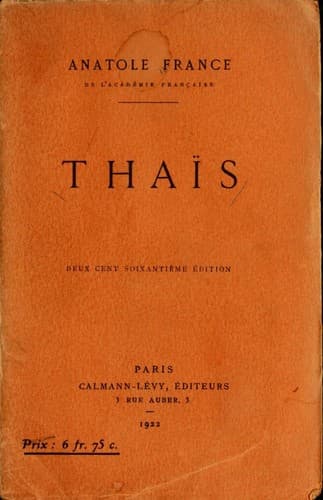
Christian women saints -- Fiction; Christianity, Conversion to -- Fiction; Courtesans -- Fiction; Egypt -- Fiction; Hermits -- Fiction
Then, raising his head, he saw, on the walls of the chamber, paintings
which represented lively and domestic scenes. They were of very old
work, and marvellously lifelike. There were cooks who blew the fire,
with their cheeks all puffed out; others plucked geese, or cooked
quarters of sheep in stew-pans. A little farther, a hunter carried on
his shoulders a gazelle pierced with arrows. In one place, peasants were
sowing, reaping, or gathering. In another, women danced to the sounds
of viols, flutes, and harp. A young girl played the theorbo. The lotus
flower shone in her hair, which was neatly braided. Her transparent
dress let the pure forms of her body be seen. Her bosom and mouth were
perfect. The face was turned in profile, and the beautiful eye looked
straight before her. The whole figure was exquisite. Paphnutius having
examined it, lowered his eyes, and replied to the voice--
“Why dost thou command me to look at these images? No doubt they
represent the terrestrial life of the idolater whose body rests here,
under my feet, at the bottom of a well, in a coffin of black basalt.
They recall the life of a dead man, and are, despite their bright
colours, the shadows of a shadow. The life of a dead man! O vanity!”
“He is dead, but he lived,” replied the voice; “and thou wilt die, and
wilt not have lived.”
From that day, Paphnutius had not a moment’s rest. The voice spoke to
him incessantly. The girl with the theorbo looked fixedly at him from
underneath the long lashes of her eye. At last she also spoke--
Public-domain text, read in full here on John Shaqi.
Reviews
Reviews
No reviews yet
Be the first to share your thoughts on this work.
Elsewhere in the archive
Join the Discussion
Join the discussion
Sign in to leave a comment or review.
Sign InorCreate an account